
The short answer
With us, most five-page small business websites cost $900 to $2,500 at a fixed price, and Shopify stores start from around $2,400. Hosting, updates and small changes run from $249 a month on a care plan. Custom features, large catalogues and web apps cost more. Every project is quoted in writing after a free 45-minute call.
Here's the direct answer. In Australia, a simple template website can start in the low thousands, a custom small business site usually costs several thousand dollars or more, and custom ecommerce often runs well into five figures. The final number depends on what the site has to do. Every project gets a fixed-price written quote after a free 45-minute discovery call. Our web design in Brisbane page explains how we work.
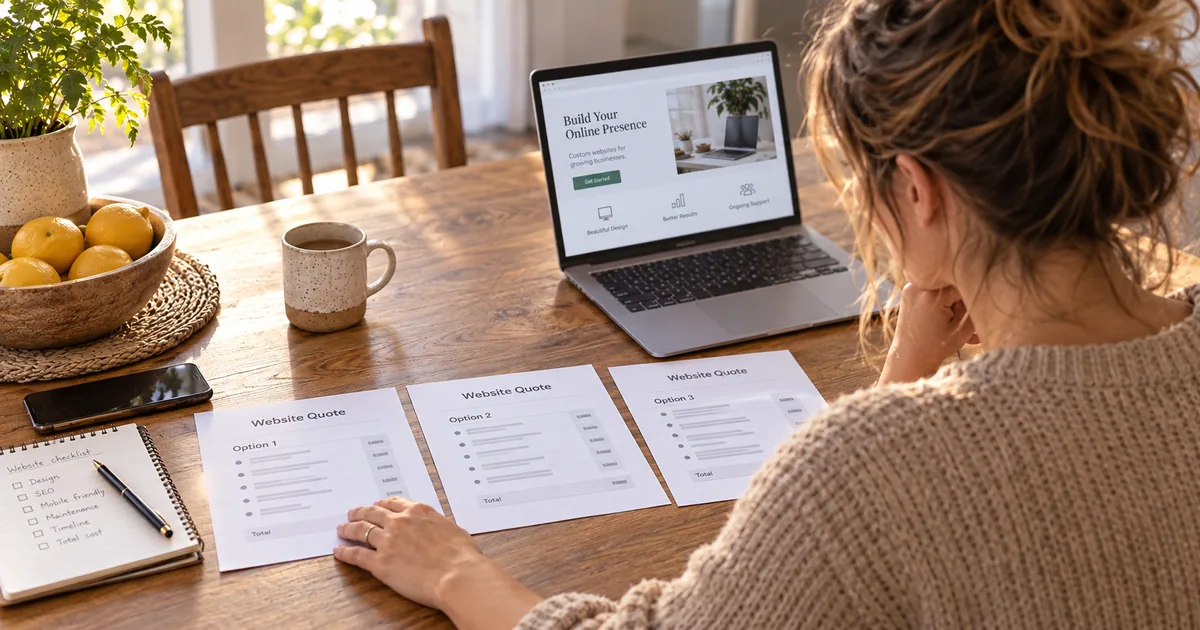
The problem: website quotes are hard to compare
Most quotes describe different things using the same words. "Five-page website" can mean a template with your logo dropped in, or it can mean research, custom design, written copy, SEO setup and training. On paper they look alike. If ongoing search work is part of the plan, our SEO Brisbane page explains what it involves.
The result is that owners often pick on price alone, then pay again a year later when the site doesn't bring in enquiries. We've rebuilt plenty of those sites over 17 years, and the second build usually costs more than doing it right the first time.
What actually drives the cost of a website
Design: template or custom
A template gives you a pre-made layout. It's quicker and cheaper, but your site may look like many others. Custom design means the layout is planned around your customers and your brand, which takes more hours.
Pages and content
Every page needs words and images. If you supply finished copy and photos, the cost drops. If we write the content and source the images, it goes up.
Platform
WordPress suits most service businesses. Shopify suits most online stores. Webflow works well for design-led sites, and a custom PHP build (We often use CodeIgniter) suits apps with unusual logic. Each has different setup time and licence costs. You can compare them on our WordPress website design and Shopify store pages.
Fun fact
W3Techs data shows WordPress powers more than 40% of all websites. That popularity is one reason it's easy to find plugins, support and developers for it.
Features and integrations
Booking systems, quote calculators, member logins, CRM connections and payment gateways all add time. So does connecting your site to tools like GoHighLevel, Xero or a stock system. A shop with 20 products is a very different job from one with 2,000 products and variants.
Who does the work
A freelancer, a local agency and an offshore team will all price differently. Ask who builds it and who will fix it in two years. Our team does everything in-house here in Brisbane.
Typical website cost tiers
These are broad Australian market ranges, not a price list. Every project is quoted on its own scope.
| Type of website | What you usually get | General market guidance |
|---|---|---|
| Starter template site | A few pages, template design, basic contact form | Can start in the low thousands |
| Custom small business site | Custom design, 5 to 15 pages, SEO setup, copy help | Often several thousand to low five figures |
| Ecommerce store | Shopify or WooCommerce, products, payments, shipping rules | Often well into five figures for custom builds |
| Custom web app or portal | Logins, dashboards, workflows, integrations | Priced on scope, often higher again |
How we price our own work
Our usual price ranges are in the table on this page, but two "five-page websites" can still be completely different jobs. We start with a free 45-minute discovery call about your business and what the site needs to do. Then we send a written quote with the scope, features and timeline spelled out, with no obligation to go ahead.
A typical small business website takes our team 1 to 2 weeks to build. Ecommerce stores and custom builds take longer, and your quote will say how long. Once the project is paid in full, you own the website, the domain, the content and any custom code.
If you're selling online, our ecommerce website design page covers what goes into a store build.
Ongoing costs most quotes leave out
The build is only the first bill. Plan for these as well:
- Domain name: a yearly fee for your .com.au or .au address, usually modest.
- Hosting: where your site lives. We run our own cPanel/WHM server in Australia that hosts 200+ client sites. See Australian hosting for details. Hosting is included in your written quote if you want it.
- SSL certificate: the padlock in the browser. Many hosts include a free one now, but check.
- Maintenance: plugin and security updates, backups and small fixes. We quote this separately, so you can see exactly what it covers.
- SEO and content: a site nobody finds won't pay for itself. We cover this in our guide to SEO pricing in Brisbane.
- Licences: premium plugins, Shopify plans, apps and email accounts.
Fun fact
The .au country domain was first delegated in March 1986. Australians have been able to register direct .au domains (like yourname.au) since March 2022.
Expert insights from 17 years of quoting
The biggest cost blowouts we see come from unclear scope, not from design. When nobody writes down how many pages, which features and who supplies content, the project drifts. A one-page scope document saves real money.
The second insight: a cheap site isn't always cheap. If it's slow on mobile or hard to update, you'll pay in lost enquiries every month. We'd rather build a smaller site well and add pages later.
Marketing tip
Before you ask for quotes, write down the one action you want visitors to take (call, book or buy) and list your ten most common customer questions. Send that to every provider. You'll get quotes you can actually compare.
Common mistakes to avoid
- Choosing the lowest quote without checking what's included
- Not owning your domain, hosting login or website files
- Skipping mobile testing (most local searches happen on phones)
- Forgetting to budget for content and photos
- Launching without Google Search Console and GA4 set up
Best practices when getting a quote
Ask every provider the same questions. Who owns the site when it's finished? What happens if you want to leave? Is SEO setup included, and what does it cover? How long is support included after launch?
Check their past work on a phone. Ask for a written scope with page counts and features. Clear quotes are a good sign of a clear process.
Practical tips for affordable web design in Brisbane
If money is tight, you still have good options:
- Start with a smaller site (5 or 6 strong pages) and grow it.
- Write your own first draft of the copy, then have it edited.
- Use a well-supported theme with custom touches instead of full custom design.
- Take your own photos of your team and your work. Real photos build trust.
Marketing tip
Set up your free Google Business Profile this week, even before the new site launches. Add photos, hours and your service areas. It can start bringing in calls while the website is being built.
Our website prices
Scope varies too much for a fixed price list, but these ranges cover most of the projects we build. Every build is fixed price, so the figure on your written quote is what you pay.
| Project | What it usually includes | Typical cost with us |
|---|---|---|
| Five-page brochure or lead-generation site | Custom layout, mobile design, contact or quote form, basic SEO setup | Most land between $900 and $2,500 |
| Shopify store | Store setup, products, payments, shipping rules | From around $2,400 |
| Larger sites, custom features, web apps | Bookings, logins, integrations, big catalogues | Quoted on scope |
| Care plan after launch | Hosting, updates, security, small changes | From $249 a month |
DIY builder, freelancer or agency
| Option | What you pay | Watch out for |
|---|---|---|
| DIY builder (Shopify, Wix, Squarespace) | A monthly plan, plus your own time. At the time of writing, Shopify's Basic plan is listed at $42 AUD a month paid yearly or $56 paid monthly | Plan fees, apps and transaction fees add up, and moving off the platform later means a rebuild |
| Freelancer | Usually a project fee | Who fixes it if they move on, and whether you get every login |
| Agency | A written quote, usually higher than a freelancer | Whether the price covers content, SEO setup and support after launch |
Not sure which platform suits you? Our comparison of WordPress vs Shopify vs Wix walks through the trade-offs.
Make sure you own the domain and the site
The most expensive website problem we see isn't the build price. It's a business that can't get into its own domain or site because a past developer registered everything in their own name.
- Domain: a .com.au must be held by someone with an Australian connection, most commonly an active ABN or ACN. Make sure that is your business, not the designer's. auDA lets you register for one to five years at a time.
- Registrar login: keep your own login to the company you pay for the domain.
- Hosting and admin: ask for administrator access to the site and the hosting account, even if you never use it.
- Contract: it should say you own the content, design and code once paid.
Already locked out? Read how to get website access back from a previous developer.
GST on website quotes
Ask whether each quote includes GST. If one says "ex GST" and the supplier is registered for GST, add 10% before comparing it with an inclusive quote. Your tax invoice should show the supplier's ABN. This is general information, not tax advice.
Budget for traffic as well
A new site needs visitors. Most owners pair it with SEO, ads or both. If you plan to advertise on social media, see how much Facebook and Instagram ads cost in Australia.
When to get help
On a discovery call we look at what the site has to do, the features it needs and who supplies the content, then quote a fixed price. Get a website quote.
About this guide
Written by Amann Jhamb, Director of AR Digital Solutions, 17 years in web design, SEO and paid ads. Last checked: 3 November 2026 against auDA: com.au domain names. Change note: updated 3 November 2026 with our price ranges, a DIY vs freelancer vs agency comparison, an ownership checklist and new FAQs. Part of our website help centre.