
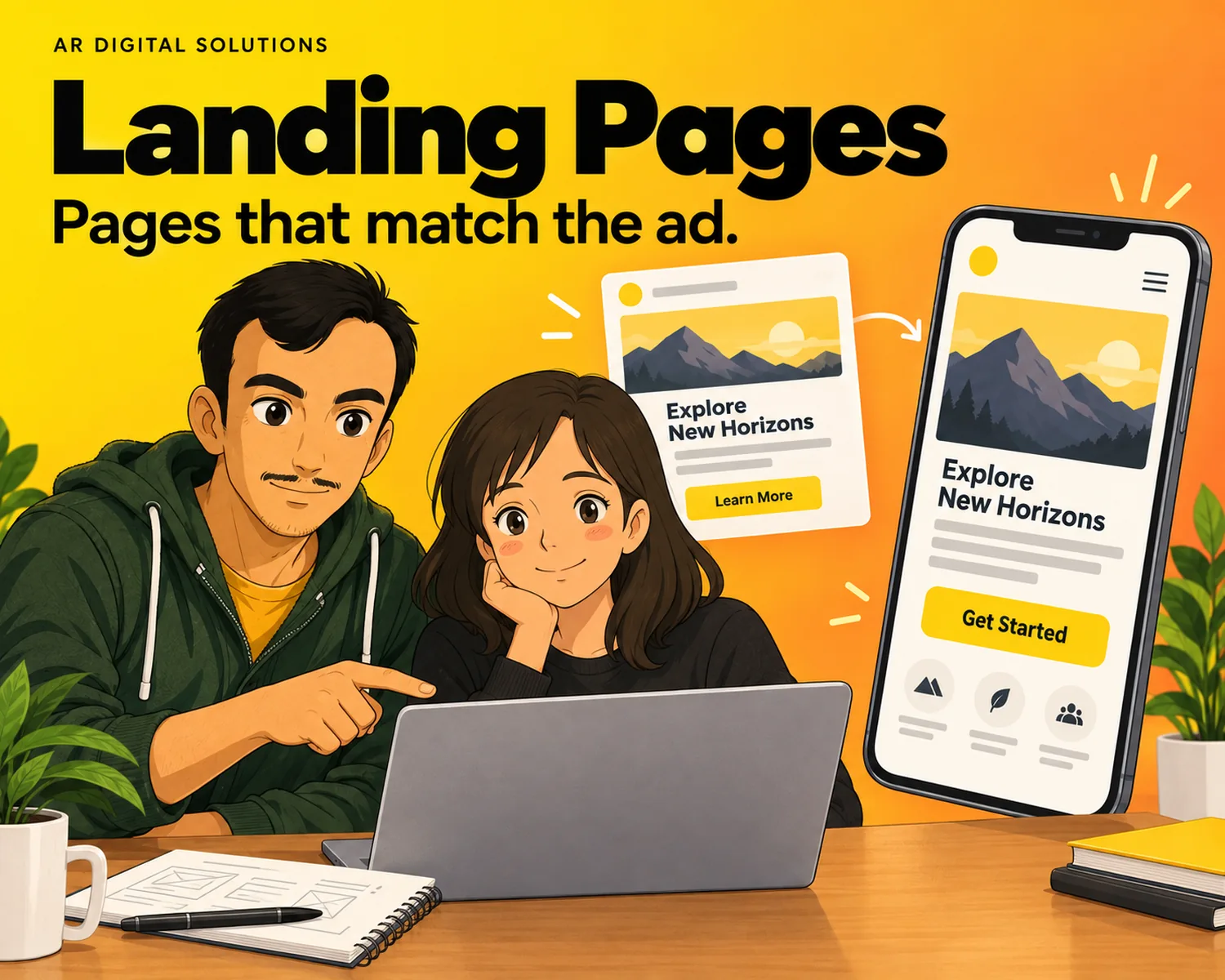
The short answer
A landing page is a single page built for one campaign and one action, with no navigation pulling people away. AR Digital Solutions designs and builds landing pages for Google Ads, Meta and email campaigns, matched to the ad that sends the traffic, and tracked so you can see what each page returns.
What you get
A page per intent, written to match the ad.
The headline repeats the search, the offer repeats the ad, and no translation is left to the visitor.
A single action.
One call to action repeated down the page, with a form or a call button sized for a thumb.
Proof placed where doubt happens.
Reviews, licence numbers and real photos, positioned next to the decision rather than parked at the bottom.
Speed.
Built light. A paid click waiting four seconds for a hero video has already cost you money.
Tracking that works.
Conversion actions, call tracking, offline import where you close on the phone.
Testing after launch.
Headline and offer variants, run long enough to mean something rather than called after nine conversions.
Message match, and why it decides everything else
If the ad says "emergency truck towing brisbane" and the page opens with "Welcome to our website", the click is wasted no matter how good the page looks. You paid for it. Someone on the shoulder of the Ipswich Motorway at 11pm wants the words "emergency truck towing" and a phone number, in that order, in under a second.
Message match is the chain running from the search term, through the ad headline, to the page headline and the offer. Same words, same promise, the whole way. Break it anywhere and the visitor has to do the translating, and they won't. They go back and click the next ad, which you're also paying for.
The fix is unglamorous. Write the page headline as the search term, in the words the customer used. If a campaign covers emergency towing and machinery transport, that's two pages, not one page mentioning both.
One page, one intent.
Every element earns its place by moving one person toward one action. Two competing calls to action halve the response to each. If you need people to ring you and to download a guide, that's two pages.
Navigation usually hurts.
Every menu item is an exit from a page you paid to fill. We drop the nav bar and keep the logo, the phone number and the legal links in the footer. The exception is a considered purchase where people need to confirm you're real. Answer that on the page, with the address, the ABN, real photos and reviews, rather than sending them to an About page they won't come back from.
What belongs above the fold.
The headline that repeats the search. One line of proof with a number in it rather than an adjective. The offer. The action, either a form with its first field visible or a call button. One image of the actual work. No slider, no mission statement, no stock photo of a handshake. On a phone that's roughly 600 pixels, so anything else goes second.
How many pages a campaign needs.
Fewer than agencies sell, more than most businesses build. One page per intent cluster, not one per keyword. A local service account with eight ad groups usually runs on three to five pages: emergency work against booked work, one per service line, and a suburb page only when the offer genuinely differs. Forty pages differing by a place name are a maintenance problem and they read as the same page.
How a landing page project runs
We read the account first
Search terms, ad groups, current conversion rate. The page gets designed against that, not a brief.
We agree the intents
How many pages, which searches each owns, what the offer is on each.
We build and instrument
Page, form, call tracking and conversion actions, checked on a real phone before launch.
We test what matters
Headline and offer first. Button colours last, if ever.
Who this suits, and who it doesn't
Businesses already spending on Google Ads or Facebook ads and sending that traffic to a home page. Trades where the enquiry is a phone call. Anyone launching an offer the main site isn't built to sell.
Not for you if you aren't running paid traffic yet. Without ads or an email list a landing page has nobody to serve, and the money is better spent on the website.
Why people pick us for this
The ads team and the page team sit together.
Whoever writes the page reads the search terms report, so the headline comes from what people typed.
We build for the phone first.
Most paid clicks in service industries land on mobile, so the layout is designed there and checked on a real device.
"We already tried landing pages and they didn't work."
Common, and it's usually that the page didn't match the ad, or it asked too much too early, or nobody tracked calls so the conversions were invisible. We find which before rebuilding anything.