
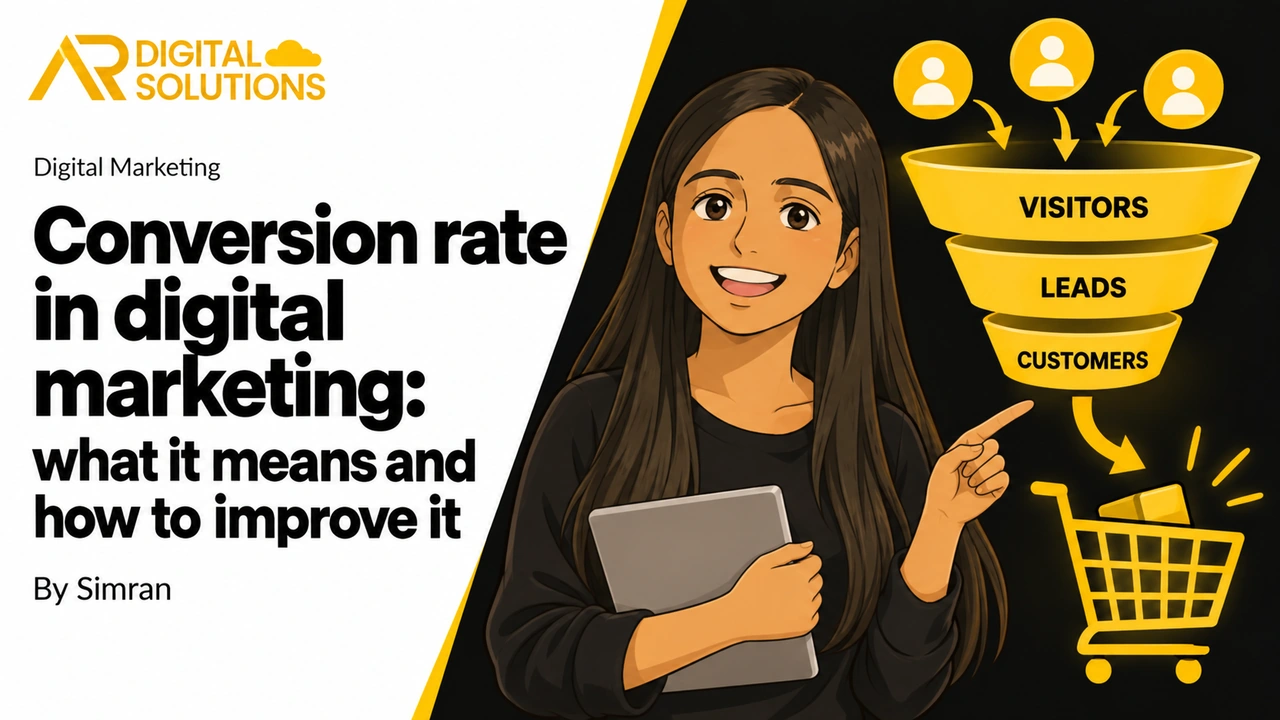
Most digital marketing conversations focus on traffic. More visitors, more clicks, more impressions. But traffic alone does not pay the bills. What matters is the proportion of visitors who take the action you want them to take. That proportion is your conversion rate.
Understanding your conversion rate, and knowing how to improve it, is one of the most direct ways to grow revenue from your existing digital marketing without spending more on advertising.
What conversion rate means
Conversion rate is the percentage of website visitors who complete a desired action. What counts as a conversion depends on your business goals:
- Submitting a contact or enquiry form
- Making a purchase
- Calling your phone number (trackable with call tracking)
- Booking an appointment
- Downloading a resource
- Signing up for an email list
To calculate conversion rate, divide the number of conversions by the number of visitors in the same period, then multiply by 100.
Example: 60 enquiry forms submitted from 2,400 visitors = 2.5 percent conversion rate.
Why conversion rate matters more than traffic volume
Increasing traffic is expensive. Each additional visitor from paid advertising has a cost. Each piece of content or SEO improvement takes time to produce.
Improving conversion rate, by contrast, multiplies the value of your existing traffic. A site converting at 1 percent that improves to 2 percent doubles its enquiry volume without attracting a single additional visitor.
This is why conversion rate optimisation (CRO) is often the most cost-efficient growth lever available to businesses with established digital marketing activity.
Factors that affect conversion rate
Many variables influence whether a visitor converts:
Relevance: Does the page they land on match the expectation set by the ad or link they followed? A mismatch between what someone expects and what they find is a major cause of high bounce rates.
Page speed: Slow loading pages lose visitors before the content even appears. This is a particularly significant issue on mobile devices.
Clarity of value proposition: Can a visitor quickly understand what you offer, who it is for and why they should choose you? If not, they leave.
Trust signals: Reviews, testimonials, industry certifications and clear contact details all reduce the perceived risk of making contact.
User experience: Confusing navigation, too many options or a form that is difficult to complete on a mobile device all reduce conversions.
Call to action quality: The text, placement and visibility of your CTA affects how many visitors take the next step.
Six practical ways to improve your conversion rate
1. Improve your call to action
CTAs should be specific, action-oriented and prominent. "Book a discovery call" performs differently from "Learn more." Action-specific language that tells visitors exactly what happens when they click tends to produce higher click-through rates.
Test different CTA text, button placement and colour. Small changes can produce meaningful differences.
2. Reduce form friction
Every additional field in a contact form reduces the completion rate. Ask only for what you genuinely need at the initial contact stage. Name, email and a brief message is usually sufficient. You can collect more information later in the process.
3. Add social proof
Customer testimonials, star ratings, review counts and case studies reduce the perceived risk of making contact. Place these near your CTAs and on landing pages rather than only on a dedicated testimonials page.
4. Improve page speed
A significant proportion of visitors leave a page that takes more than 3 seconds to load on mobile. Compressing images, minimising scripts and using a fast hosting platform all contribute to faster load times.
5. Test pages systematically
A/B testing involves showing two versions of a page to different visitors and measuring which converts better. This replaces guesswork with evidence. Test one element at a time, such as headline, CTA text or page layout, so you can identify what changed the outcome.
6. Match the page to the intent of the visitor
Different traffic sources arrive with different levels of intent. Organic search visitors looking for a specific service are often close to a decision. Social media visitors may be much earlier in the process. Landing pages should match the intent of the source rather than taking everyone to the same generic page.
Tracking your conversion rate
Google Analytics 4 tracks conversions when set up correctly with goals. Phone call tracking tools can log calls as conversion events. Form submission tracking records when your contact form is completed.
Without tracking, you cannot tell whether your conversion rate is improving or declining. Setting this up correctly is a prerequisite for meaningful CRO work.