
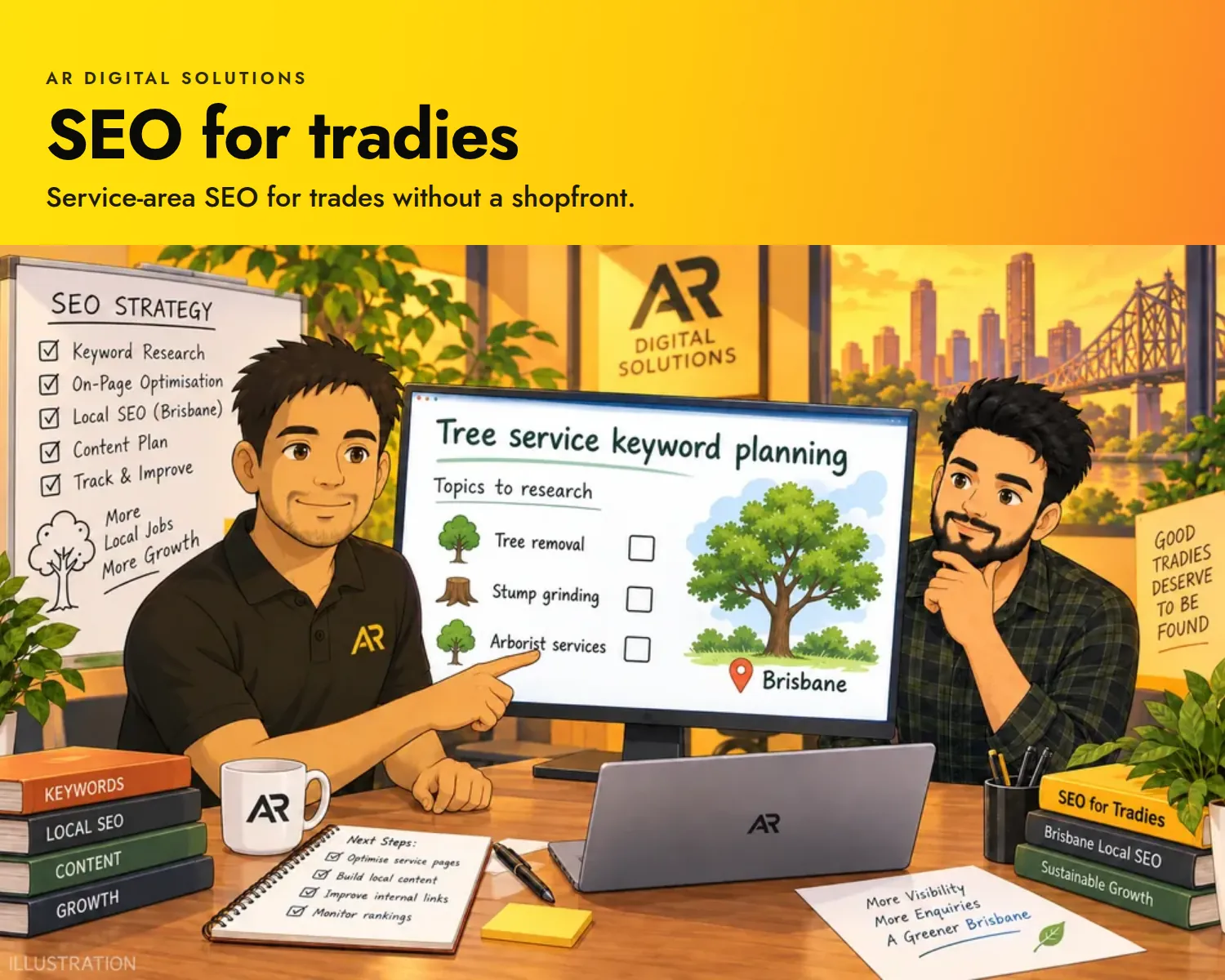
The short answer
- Most trade jobs are won in the Google map results, not the blue links underneath.
- A van-based business with no shopfront can rank, but it has to be set up as a service-area business, not a fake address.
- Suburb pages work when there is real search demand behind them. Built for suburbs nobody searches, they sit unindexed.
- Reviews are the lever most tradies leave alone, and they are the one that moves the map results fastest.
- SEO plans start from $900 a month, month to month, with no fixed-term lock-in.

Most tradies come to us the same way. They have been buying leads off a directory, the price per lead keeps creeping up, and the same job gets sold to four other blokes before anyone picks up the phone. SEO is the other option. Your own Google listing and your own website turn up when someone nearby searches for the work you do, and nobody charges you for the call.
This page covers how that actually works for a trade business, what we do month to month, and what to expect before the phone starts ringing differently.
Why the map pack decides most tradie jobs
Search "electrician near me" on a phone and you get a map with three businesses under it. On a mobile screen that block fills almost everything above the fold. Someone with a dead switchboard is not scrolling past it.
Google ranks that block on three things it publishes openly: how relevant your listing is to what was typed, how far you are from the person searching, and how prominent your business is across the web. Reviews, citations and your website's own authority all feed that last one.
Distance is the part nobody can talk their way around, and it is the part most agencies skip over when they sell you a package. A search from Carindale is not going to serve a business registered in Ipswich, no matter how good the listing is. That single fact shapes everything else. The map results will win you the suburbs around your base. For the rest of your service area, the website has to do the work.
Tradie SEO in Brisbane
Greater Brisbane is really several council areas: Brisbane, Logan, Ipswich, Moreton Bay and Redland. Customers search by their own suburb, not by council, so a tradie based in Pallara might win "electrician Forest Lake" in the map pack and still be invisible in Springfield or Carindale. Google Business Profile lets you list up to 20 service areas, but listing them does not make you rank there. The website has to back them up.
Budget Tree Removal shows how that plays out. As of 17 September 2026 it held #3 for "emergency tree removal brisbane" and #1 for suburb terms such as "tree removal Hamilton" and "tree lopping Fitzgibbon" (SE Ranking rank tracking, Google Australia). Those suburb wins came from pages with real local content, not a list of postcodes.
Our SEO Brisbane service covers the website side, and local SEO covers the map pack and service areas across South East Queensland.
Ranking a service-area business with no shopfront
If customers do not come to you, your address should not be public. In Google Business Profile that means clearing the street address and setting service areas instead. Hiding the address does not hurt you. Publishing a home address you do not trade from, or renting a mailbox in a suburb you want to rank in, will eventually cost you the listing.
From there the basics matter more than anything clever:
- One primary category that matches the trade, with secondary categories only where you genuinely do the work.
- Business name, phone and address written identically everywhere they appear, including on your own site.
- Every service listed individually on the profile, not lumped into one line.
- Photos from actual jobs, added as you go, rather than a stock library uploaded once.
- Hours that match reality, including whether you answer after hours.
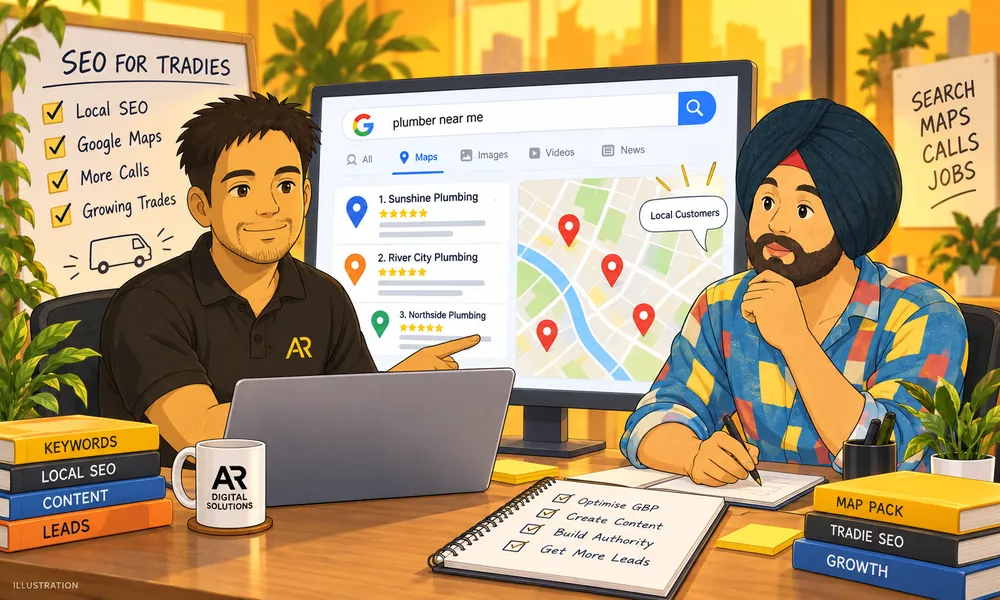
Suburb pages that work, and the ones Google ignores
Every tradie has been sold suburb pages. Most of what gets built is a template with the suburb name swapped in, and Google has been filtering that for years.
We know exactly where the line sits because we tested it on our own site. In September 2026 we ran all 491 of our service-area keywords through the SE Ranking API on Google Australia. Of those, 371 rank in the top 100, 297 are in the top 10, and 128 sit at number one. That is the good half of the result.
The other half was more useful. The pages that were not indexed at all were almost entirely the ones built for suburb terms with no recorded search volume behind them. Google crawled them, found nothing wrong with them, and had no query stream to serve them into. Nobody was searching, so nobody got the page.
So the rule we use now is straightforward. Build a page for a suburb where there is measured demand, and make it genuinely about that suburb: the type of housing, the age of the stock, the jobs that actually come up there, the work you have done nearby. Where there is no demand, cover the area inside a regional page instead of spinning up another URL.
Getting reviews while you are on the tools
Review count and review recency both feed the map results, and this is the piece that slips because you are busy.
What works for the trade clients we run is asking at the end of the job, face to face, while the customer is standing next to the work. Then send the review link by text before you drive off. Keep that link saved in your phone so it takes seconds, and put a QR code on the invoice for the ones who mean to and forget.
Two things to avoid. Do not filter who you ask based on how you think they will rate you, because Google treats that as review gating. And do not buy them. Bought reviews can cost a listing its history, and rebuilding from there is slower than starting fresh.
Reply to every review, including the rough ones. The reply is read by the next customer far more often than by the person who left it.
What a month of work looks like
The first month is groundwork. We audit the site, fix what is broken technically, claim or rebuild the Google Business Profile, set up call and rank tracking so there is something to measure against, then agree the page plan.
From month two it splits into content and authority. Service pages get rewritten so each one answers the question a buyer actually has. Priority suburb pages go up in order of demand. Citations get cleaned so your details match across the directories that still count, and reviews get chased properly.
After that it settles into a monthly rhythm: new pages, profile posts, technical maintenance, and a report showing positions, calls and form enquiries rather than a graph of impressions.
On timing, be realistic. In the client work we track, map-pack positions usually move before organic ones, and competitive suburb terms are the slowest of the lot. Anyone promising you page one by a fixed date is guessing.
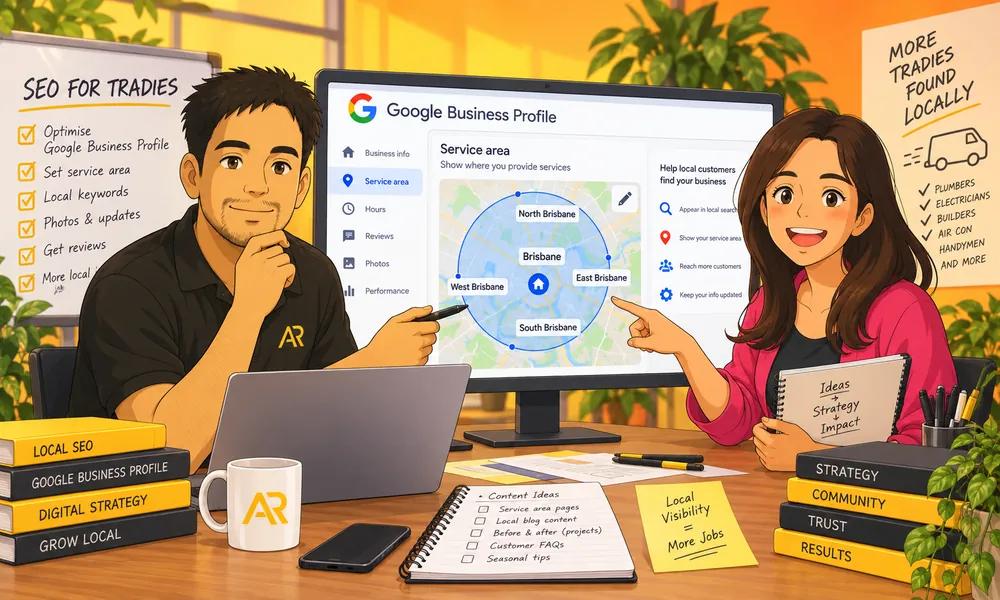
What it costs
SEO plans start from $900 a month. Work is month to month with no fixed-term lock-in and 30 days' notice, though some SEO projects need the first three months paid up front, which we state in the proposal rather than springing on you later.
If the website itself needs work, that is quoted as a fixed price in writing after a free 45 minute discovery call. There is no price list because a sparky covering four suburbs and a roofing company covering a whole metro are not the same job.
Results from trade clients
All figures below are from SE Ranking tracking as at 17 September 2026.
Budget Tree Removal, a Brisbane trade business running SEO, content and Google Ads together: 39 of 154 tracked keywords on page one, and 120 of them inside the top 30.
Delta Heavy Towing, Brisbane heavy towing: 77 of 148 tracked positions on page one across Brisbane and Toowoomba, with 40 sitting in the top 3.
Affordable Skippy Bins, skip bin hire, built suburb by suburb: 38 keywords on page one, 24 in the top 3, and 87 of 149 tracked inside the top 30.
Where we work
Brisbane. This is home. The office is at 1 Cheshire St, Pallara, and every trade result on this page came from a Brisbane client. Brisbane rewards suburb work more than most capitals because the metro sprawls from Caboolture down to Beenleigh and out to Ipswich, so one listing cannot cover it on proximity alone. Storm season from November through February also drags a year's worth of emergency searching into a few weeks, and the businesses that rank through it are the ones that did the work in winter.
Melbourne. We work with Melbourne businesses from here. The market is tighter and more contested, partly because there are more agencies per trade and partly because the suburb grid is denser, so two competitors are often minutes apart and proximity stops separating them. That pushes the weight onto reviews and onto how well the site covers the service. One practical note: Queensland does not run daylight saving, so from October to April we are an hour behind you, and we book calls to suit your day rather than ours.
Sydney. Also serviced from Brisbane. Sydney is the one market where travel time matters more than distance on a map. The harbour and the tolls mean a business in Parramatta chasing eastern suburbs work is competing against someone five minutes from the job, and it is usually smarter to own a corridor properly than to claim the whole basin. Sydney is also the most expensive market for paid clicks in the trades, which makes the organic and map work pay back faster there than anywhere else.
Your trade
The detail changes a fair bit between trades, so we have written these separately:
- SEO for electricians, covering emergency call-outs, switchboard and EV charger work, and licence trust signals.
- SEO for plumbers, covering burst pipes and blocked drains against planned bathroom work.
- SEO for roofers, covering storm demand, insurance enquiries and long quoting cycles.
For the web design side of working with trades, see SEO and web design for tradies. If you only work one city and want the local detail, local SEO in Brisbane goes deeper on the map pack.
Talk to someone who has done it
AR Digital Solutions is run by Amann Jhamb, who has been doing this for 17 years, with an in-house team in Brisbane rather than subcontractors overseas. We are rated 4.9 from 86 Google reviews.
Call 07 3067 8910 or get in touch and we will look at your listing and your site, and at what your competitors are ranking for, before you commit to anything.
---