
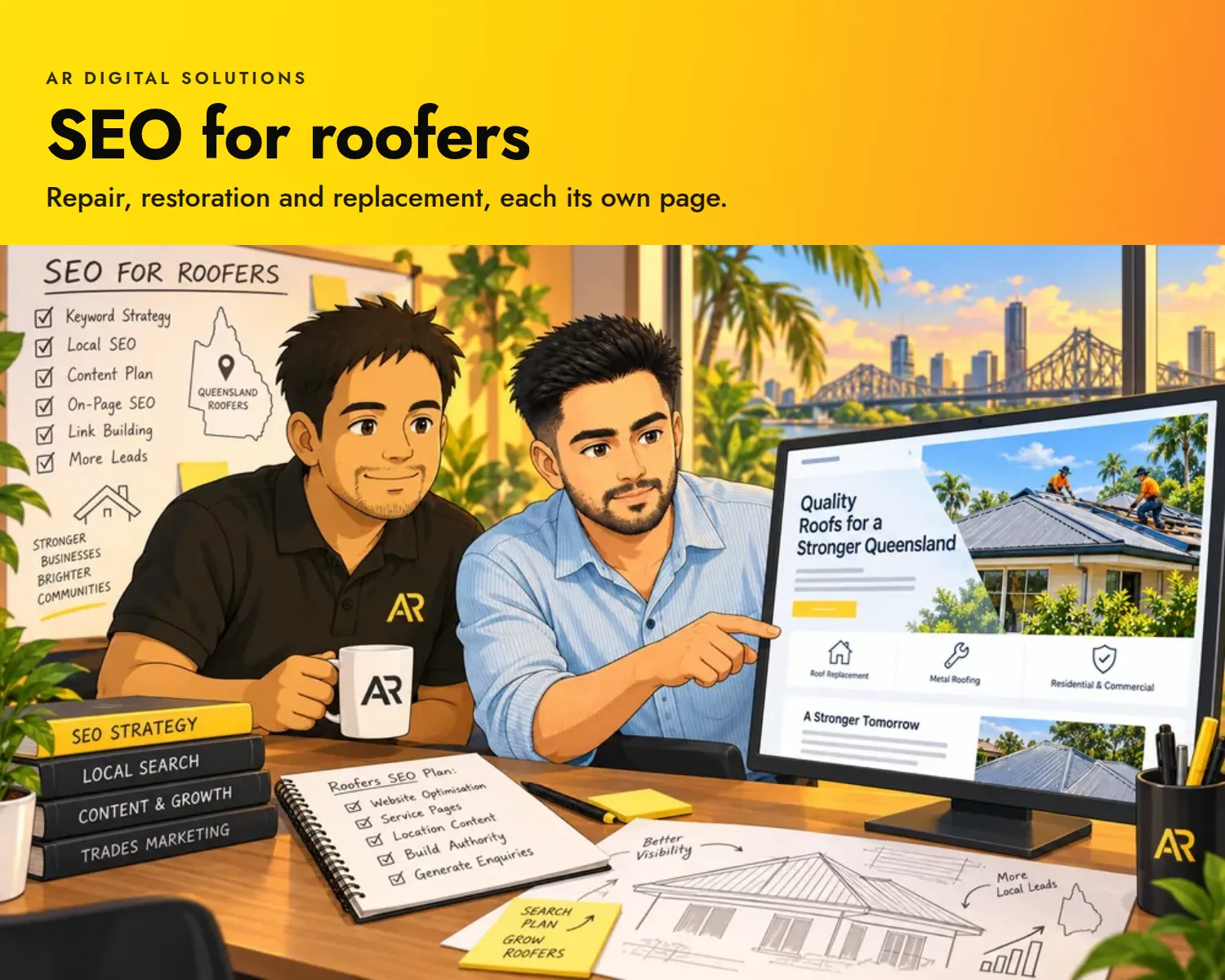
The short answer
- Storm demand cannot be chased in real time. Position has to be earned in the quiet months.
- Repair, restoration and replacement are separate searches with separate budgets, and they need separate pages.
- Insurance enquiries behave differently to cash jobs and should have their own page explaining the process.
- Photos of your own completed roofs do more for conversion on this trade than any other change to the site.
- Licence details, warranty terms and insurance cover need to be visible, because the job is expensive and the buyer is cautious.

Roofing is the trade where timing decides the year. Demand arrives in bursts after weather, and the businesses that clean up in those weeks are the ones that were already ranking when the storm hit. You cannot start SEO the morning after a hailstorm and expect to be found by lunchtime.
The rest of the year is slower, more considered work. Restorations and full replacements get quoted against two or three competitors and decided over weeks. This page covers how we build for both, and what a roofing site needs to carry before either type of enquiry converts.
Getting ready before storm season, not during it
In South East Queensland the storm season runs from about November to February, and a single bad afternoon can generate more roofing searches than the preceding three months. Melbourne gets its damage in short hail events. Sydney gets it from east coast lows. The pattern differs but the lesson is the same everywhere: the search spike lasts days, and rankings take months.
So the work is counter-seasonal. Winter and early spring are when the storm damage pages get written, the roof repair and emergency tarping pages go up, the Google Business Profile gets its services and photos sorted, and reviews get chased. By the time the weather turns, the pages have been indexed long enough to hold position.
There is a short-term lever as well, and it is honest to name it: Google Ads works from the day you switch it on, with no ranking required. For a roofing business the sensible pattern is organic and map work building through the quiet season, with paid search used to buy the spike when it comes. One of our trade clients runs exactly that combination.
Roofing SEO in Brisbane
Roofing searches in Brisbane are lumpy. A hail cell crossing a few suburbs can send searches like "roof repairs [suburb]" climbing for days, mostly from people on phones who ring whoever appears in the map pack with decent reviews. Restoration and replacement searches are steadier and slower, and buyers compare several roofers before booking a quote.
Because roofers usually travel further than most trades, service areas across South East Queensland need care. Google Business Profile allows up to 20 service areas, but your listing will still mostly show near your base. The website has to cover the rest, with pages for each type of roofing work and suburb pages where there is measured demand.
Our local SEO service handles the map pack and service areas, and our Brisbane SEO team handles the pages and technical work behind them.
Repair, restoration and replacement are different buyers
These get bundled into one services page on most roofing sites, and they are not the same enquiry at all.
Repairs are urgent and low value. A leak in a bedroom ceiling gets searched on a phone, and the map results take most of that traffic. The page needs to be quick, the number needs to be tappable, and the copy should say how fast you can get there.
Restoration is a considered purchase, usually driven by how the roof looks or by a pending sale. These people search for what the process involves, whether it is worth doing against replacing, and how long it lasts. Explain the steps properly, including the parts customers do not expect, such as the repointing and the preparation before anything is sprayed.
Replacement is the biggest ticket and the longest cycle. Tile against metal, what the roof needs structurally, how long the house is exposed during the change, and what happens if it rains mid-job. Answer those on the page and you will be in fewer three-way quote comparisons that come down to price alone.
Each of these deserves its own page with its own photos. Three strong pages beat one page that mentions everything.
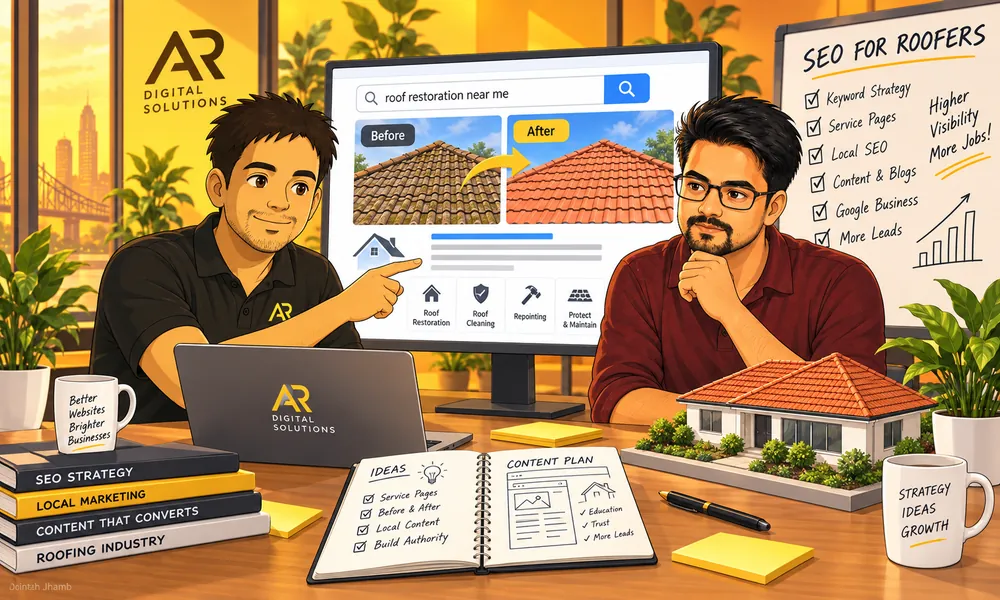
Insurance work needs its own page
A homeowner with storm damage and an insurance claim is in a different frame of mind to someone buying a restoration. They are not sure what the insurer covers, whether they can choose their own roofer, or what a make-safe is. Most of them are searching those questions before they search for a roofing company.
A page that explains how a claim runs from first inspection through to the report, what documentation you provide the insurer, and how emergency make-safe works, will bring in enquiries that competitors are not even bidding on. It also sets the expectation that you deal with insurers regularly, which is a large part of why that customer picks a roofer.
Be careful with the claims you make. If you are not a preferred repairer for particular insurers, do not imply it.
Quoting from photos, and using it as a conversion tool
Most roofing enquiries now start with the customer standing in the yard taking a photo with their phone. Make that the path.
Put a short form on the site that takes photos directly from the phone camera, asks for the suburb, the roof type and what they have noticed, and nothing else. Tell them what happens next and when. It removes the awkward step of arranging access for a first inspection, and it lets you filter out the jobs that are not worth a truck roll.
It also gives you a reason to follow up properly. A quote sent with annotated photos of their own roof is far harder to ignore than a price on letterhead, and it gives you something to reference when you ring a week later.
Proof, because the sale takes weeks
Roofing has a long cycle and a nervous buyer, so the website's job is to remove risk.
- Galleries by job type and by suburb. Before and after images of restorations, and progress shots of replacements. Caption them with the suburb, the roof type and how long the job took.
- Warranty terms in writing. State the length and what it covers. A vague promise of a warranty is worth less than a specific one.
- Licence and insurance. Put the QBCC or equivalent licence number and your public liability cover in the footer of every page, not only on the About page.
- Reviews, kept current. Ask on the day the scaffold comes down while the customer is looking at the finished roof.
- Named local jobs. Suburb-level proof does more than a generic testimonial, because the person reading is deciding whether you work near them.
That last point also feeds how AI search tools answer questions like "who does roof restorations in my area". They assemble answers from pages with specific, verifiable detail on them. Pages of adjectives give them nothing to use.
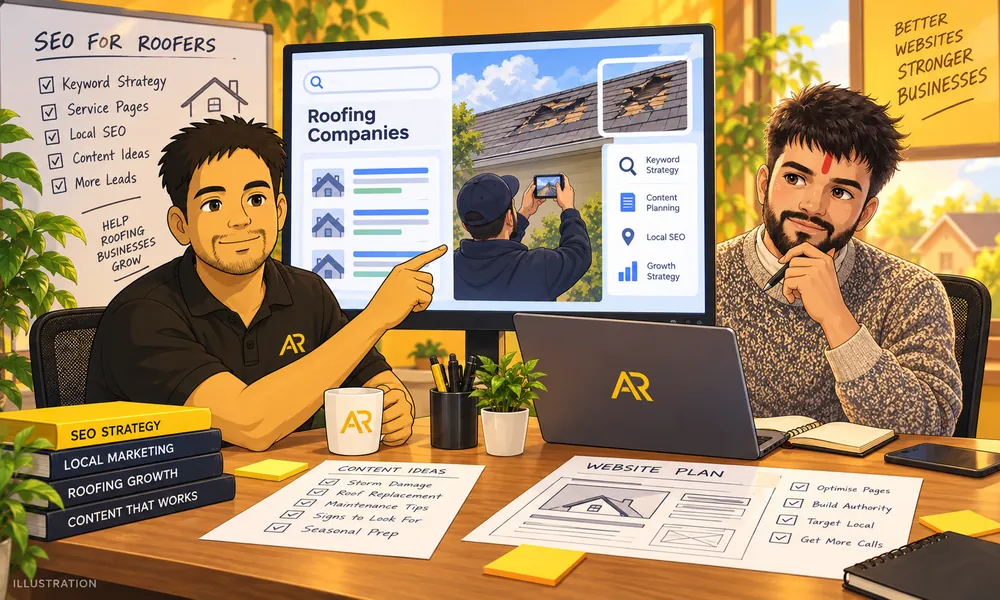
Suburb pages that hold up
A roofing business covers a wide area, and the map results will only reach so far because distance from the searcher is one of the factors Google uses. Suburb pages fill the gap, but only when they are built where there is real demand.
We tested this on our own site. In September 2026 we scanned all 491 of our service-area keywords through the SE Ranking API on Google Australia: 371 rank in the top 100, 297 in the top 10, and 128 at number one. The pages Google had declined to index were almost entirely the ones targeting suburb terms with no recorded search volume behind them. The lesson carried straight into how we build for clients. Where demand exists, write the page and make it genuinely local, covering the roof types common in that area and the jobs you have done nearby. Where it does not, cover the suburb inside a regional page.
Results from our trade clients
All figures from SE Ranking tracking as at 17 September 2026.
Budget Tree Removal, a Brisbane business with the same storm-driven demand pattern as roofing, running SEO, content and Google Ads together: 39 of 154 tracked keywords on page one, 120 inside the top 30.
Delta Heavy Towing, Brisbane heavy towing: 77 of 148 tracked positions on page one across Brisbane and Toowoomba, 40 of them in the top 3.
Affordable Skippy Bins, built suburb by suburb: 38 on page one, 24 in the top 3, 87 of 149 in the top 30.
Where we work
Brisbane. Our office is at 1 Cheshire St, Pallara, and all of the client results above come from Brisbane businesses. Brisbane roofing has a clear seasonal shape, with the storm season from November to February driving repair and insurance searching, and a long steady run of restoration work on the tiled roofs across the older suburbs. Our tree removal client rides the same weather cycle, so we have run the counter-seasonal build for real rather than in theory.
Melbourne. Melbourne roofing businesses work with our Brisbane team. The seasonal pattern is different there. Damage tends to come from concentrated hail events rather than a months-long storm season, and the slate and older tile stock in the inner suburbs makes the restoration conversation a different one to ours. Competition is denser too, with more operators within the same few kilometres, which puts the weight on reviews and site quality rather than proximity. Queensland has no daylight saving, so between October and April we are an hour behind you and book calls accordingly.
Sydney. Also serviced from Brisbane. Sydney's damage events come mainly from east coast lows and the associated wind, and the service-area maths there is about travel time rather than distance, because a job across the harbour is an hour you do not get back. Most roofing businesses do better owning a region properly than spreading across the basin. Sydney also has the dearest paid clicks in the trades, so map and organic positions are worth more per place gained.
Next steps
This page sits under SEO for tradies, which covers the map pack, reviews and the month-to-month process across trades. For website work specifically, see SEO and web design for tradies, and for the local layer in one city, local SEO in Brisbane.
AR Digital Solutions is led by Amann Jhamb, 17 years in the industry, with an in-house team in Brisbane. Rated 4.9 from 86 Google reviews.
Call 07 3067 8910 or contact us and we will look at your listing and your site, and the searches your competitors are winning, well before the next storm season.
---