
The short answer
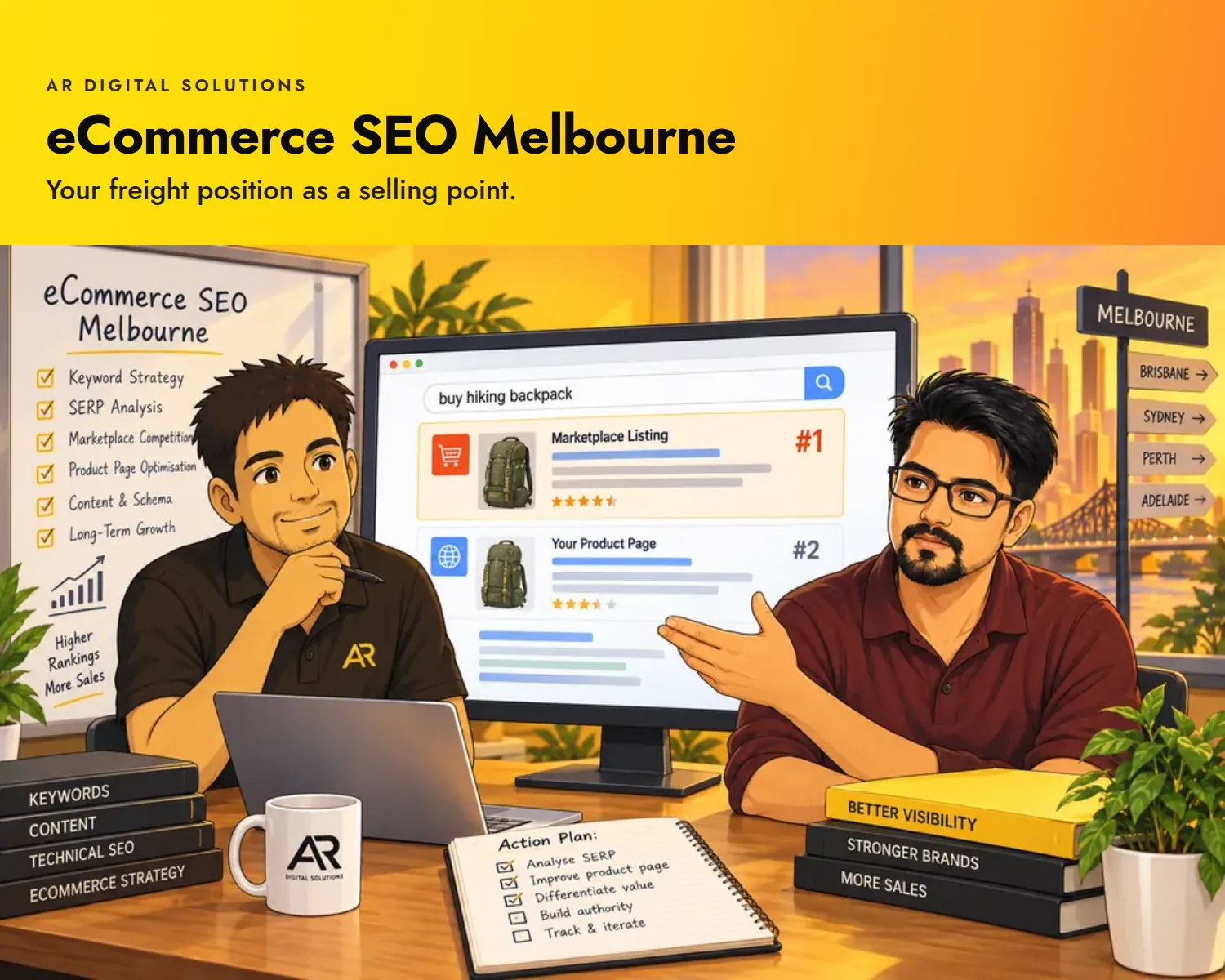
Melbourne is the easiest Australian capital to run a national online store from, and almost none of the reasons are marketing reasons. They are freight, warehousing and a customer base with genuine seasons. Most Melbourne stores never write any of that into their website, which is where the search opportunity sits. About 170 people a month search "ecommerce seo melbourne".
One thing to get out of the way first. AR Digital Solutions is based in Brisbane. We do work in Melbourne, Blue Chip Properties at Ravenhall among others, but that is a property advisory business rather than an online store. We do not have a Melbourne ecommerce client with published ranking figures, and we are not going to imply otherwise further down the page.

A national catalogue ranking on brand pages
Shopace is a national workwear and uniform brand run out of Brisbane. It sells the big trade labels online across Australia, and the pages carrying its search traffic are the plain brand pages: /as-colour/, /hard-yakka/, /biz-collection/.
Those brand terms are big. "as colour" runs at 60,500 searches a month, "hard yakka" at 12,100. Read from the SE Ranking API in September 2026, the domain holds 977 organic keywords with 40 in the top five.
For a Melbourne store the lesson is about where the state line stops mattering. Your freight advantage into Victoria is real and worth writing into product pages, as above. On a brand category term it counts for nothing, because the result has no local intent in it. Those pages are won on structure and stock depth, and a Brisbane catalogue proves it can be done from anywhere.
Shopace is a Brisbane business selling nationally, so a Melbourne store is competing on exactly the same result pages. Nothing about the state line changes the structure that wins them.
What we can show you, and what we cannot
There is no Melbourne ecommerce case study here. We do have a Melbourne client, Blue Chip Properties at Ravenhall, a property advisory business where the owner reports four to eight leads a day from the Meta advertising we run. That is a different service line and a different industry, so it tells you we work in this city, not that we have grown a Melbourne online store.
The ecommerce result we do have is Punjabi Furniture, a Brisbane furniture retailer, where we built 59 pages of content. As at 17 September 2026 SE Ranking has 53 of their 98 tracked keywords on page one of Google Australia, with 35 inside the top three. The owner reports revenue has tripled since the work began. That figure is the client's own, and it belongs to the whole programme: we designed and built the site, run the SEO, and run the Google Ads and Meta Ads. No single channel tripled a retailer's revenue on its own. Those are positions rather than revenue, and they come from a keyword list agreed with the client rather than the whole category.
Our own site is the other piece of evidence, and it is the one we control. A scan through the SE Ranking API on 21 September 2026 across 491 service area keywords on Google Australia found 371 in the top 100, 297 in the top 10 and 128 sitting at number one.
Your freight position is a selling point you have not written down
Melbourne sits at the middle of the Australian carrier network. The warehousing corridor through Truganina, Derrimut and Laverton North in the west, plus Dandenong South in the south east, is where a large share of national parcel volume starts its day. A Melbourne store frequently quotes lower national freight than a Brisbane or Perth store selling the identical product.
Almost every Melbourne store turns that into the same three words: free shipping Australia wide. Which tells a buyer nothing, because everyone says it, and earns nothing in search, because there is no query for it.
The version that works is specific. "Most Victorian orders arrive next business day. Sydney, Canberra and Adelaide in two. Brisbane in three. Perth four to six." Put it on the product page, not the policy page. It answers the actual question the buyer has, it reduces the enquiry emails asking when something will arrive, and the specific phrasing picks up long tail searches about delivery times that generic copy never touches.
If you drop ship part of your catalogue and warehouse the rest, be honest about which is which on the product page. Buyers forgive a longer wait they were told about. They do not forgive one they discovered after paying.
Melbourne seasons run on a timetable, and the SEO calendar has to run ahead of it
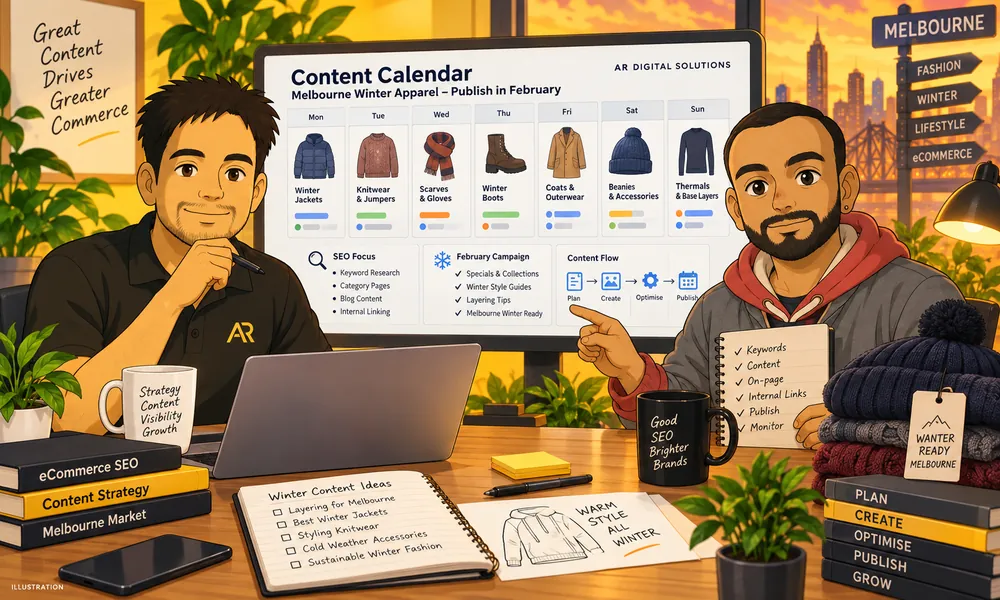
Melbourne has the widest seasonal swing of the eastern capitals for anything people wear or heat with. That is a commercial advantage, because a real winter creates real demand in categories that barely move in Brisbane. It is also a trap, because store owners plan content at the moment they feel the season change.
A Melbourne apparel store building its wool coat content in May has already lost the year. A category page needs months, not weeks, to be crawled, indexed and settled into a position, and it then needs to accumulate behaviour before it holds. Winter category work starts in February. Summer starts in August. Heating starts in March, cooling in September.
There is a second layer to this that catches national sellers. Your Melbourne customers are buying coats while your Queensland and WA customers are not. If your collection pages are organised by season, half your catalogue is irrelevant to half your customers for half the year. Organise by use and material where you can, and let the seasonal pages sit above them as a landing layer that you rebuild each year on the same URL rather than deleting and recreating.
Two addresses is the most common technical mess we find in Melbourne
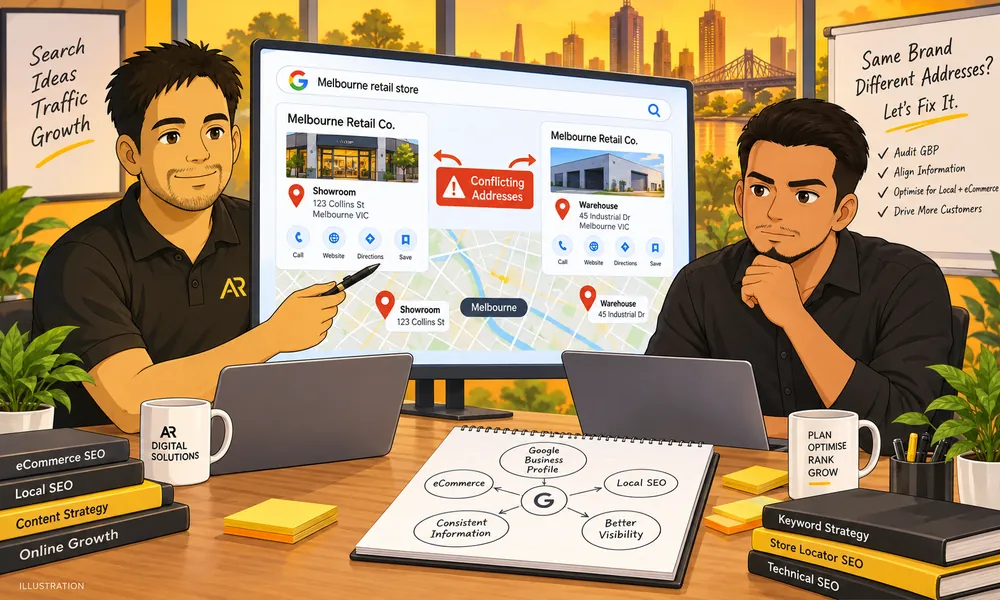
The pattern is showroom in Richmond, Collingwood, Fitzroy or Brunswick, warehouse somewhere in the west or the south east. It is a sensible way to run a business and it wrecks local search when nobody is looking after it.
What we usually find:
- Two Google Business Profiles with different phone numbers, both half finished, reviews split between them.
- A locations page that lists the warehouse as though customers can walk in, so people turn up at a loading dock.
- Contact details in the footer that match neither profile.
- LocalBusiness schema carrying one address while the profile that actually ranks carries the other.
The fix is not complicated and it is rarely done. Decide which address is customer facing. Make the other one either a non-visitable location or not listed at all. Then make the footer, the schema, the contact page and the Google Business Profile agree word for word, right down to whether you write "St" or "Street". Consolidate the reviews onto the profile you are keeping. It sounds like housekeeping. It is frequently the difference between appearing in a map pack and never appearing in one.
Your own eBay listing is beating your product page
Melbourne has an unusually high density of sellers running a store alongside marketplace channels. Search your own product name and see what comes up. If an eBay, Amazon or Catch listing of yours sits above your own product page, you are paying commission on a sale that was already going to be yours.
It happens because marketplace domains carry enormous authority and your product page is thin by comparison. Manufacturer copy pasted into both makes it worse, because Google then has two near identical pages and picks the stronger domain.
What to do about it. Make your product page the better page, not the same page written twice. Marketplace listings are constrained by a template. Yours is not. Your page can carry full specifications, fitment or sizing detail, a video, a comparison against the two products people cross shop, review markup with real reviews, and a named warehouse with a dispatch cut off. Write different copy for the marketplace listing. Put your brand name in the marketplace title so brand searches land somewhere you control either way. Then link the marketplace listing back to your store where the platform allows it.
The Melbourne categories, and where link earning is actually realistic
The categories we see most in Melbourne are apparel and footwear, coffee and specialty food, homewares and design, auto parts and performance, cycling, art and craft supplies, and hospitality equipment.
There is a pattern worth acting on. Melbourne's design, food and cycling scenes produce a lot of small brands that get written about by people who are not paid to write about them. If your store is one of those, links are genuinely earnable, and that changes where the effort should go. Less time on filter cleanup, more time on the pages that get cited: the process page, the sourcing story, the comparison nobody else has bothered to run properly.
If your store is a commodity reseller with no story, the opposite applies. Links will be slow and expensive, so the gains sit in structure, product data and the qualified long tail instead. We will tell you which one you are in the audit rather than selling you the same plan either way.
How the work runs
The method itself is on our national eCommerce SEO page: catalogue audit first, then structure, faceted navigation and product data, then the missing pages, then reporting on organic revenue by category rather than a list of positions. What is set out above is what we would sequence differently for a Melbourne store.
Everything sits in accounts you own. Reporting is monthly and written in plain English. Retainers run month to month and there is no lock in.
Who you are dealing with
AR Digital Solutions has been going since 2009, from 1 Cheshire St, Pallara in Brisbane, with an in house team of 32. Amann Jhamb has 17 years in web design and search. We are a Shopify Partner and a Meta Business Partner, with 86 Google reviews at 4.9.
Questions Melbourne store owners ask us
We already rank well in Victoria. Why would we bother with more? Because Victoria is roughly a quarter of the national market and your freight position means the other three quarters are cheaper for you to serve than for most of your competitors. Ranking well in one state is usually a sign the structure works and the coverage does not.
Our old developer built the site and left. Can you take it over? Yes. That is a fair share of the work we pick up. The first month is usually spent finding out what was actually done before anyone changes anything.
Can you fix a replatform that lost us traffic? Often, and the sooner the better. It is normally missing redirects, a changed URL pattern or a sitemap that never got resubmitted. Recovery gets harder the longer the wrong URLs sit in the index.
Do you work in Australian hours? Yes. We are on Queensland time, so for half the year Melbourne is an hour ahead of us. It has never been a problem for anybody.
---