
The short answer
SEO for Australian medical clinics and GP practices. AHPRA and TGA advertising limits, bulk billing search intent, doctor bios, booking systems, accessibility.
A medical centre has a different search problem to most local businesses. Demand is not the issue. People are looking for a GP constantly, and in most suburbs there are more patients than appointments. The problem is that the searches which matter are narrow and operational, and most clinics are invisible for them. On top of that, the rules about what you may say are tighter here than in almost any other sector.
This page covers what practice managers can realistically do about that, and where the limits sit.
AR Digital Solutions provides marketing services. We do not provide clinical or regulatory advice. Confirm your obligations with AHPRA and the Medical Board of Australia, with the TGA where medicines or therapeutic goods are involved, and with your professional association, before you publish.
What patients are actually searching
Access questions. "gp accepting new patients", "doctor open sunday", "after hours gp near me", "walk in medical centre". These are the highest intent searches in the sector and they are answered by facts, not marketing copy. Whether you are taking new patients, your real opening hours, whether you take walk-ins, and how long the current wait is. Most clinic sites answer none of these on a page Google can read, because the answers sit inside a booking widget.
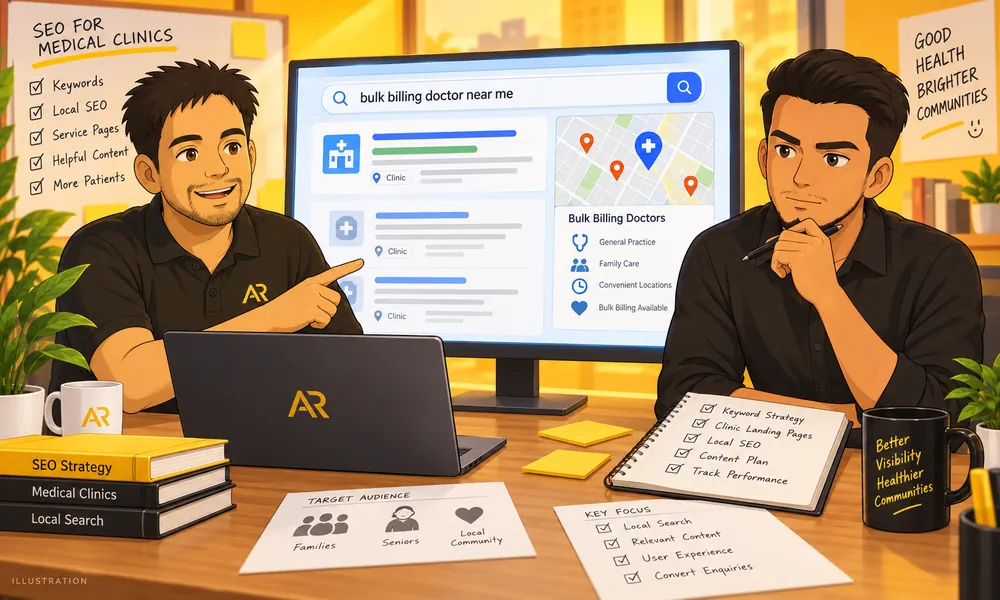
Bulk billing. Consistently one of the most searched terms in Australian healthcare. It is also the one clinics handle worst, because the arrangement is usually conditional. Saying "bulk billing available" helps nobody. Say who is bulk billed, under what conditions, and what the out-of-pocket is otherwise. If your position changes, change it on the site and in Google on the same day, because a patient who arrives expecting no fee and gets one leaves a review about it.
Service-specific. Skin checks, travel vaccination, iron infusions, women's health, mental health care plans, driver medicals. These are the pages that bring in patients from outside your immediate catchment, and they are usually thin or missing.
Named doctor. People search for a specific doctor by name, often after a referral or because they followed a GP from another practice. If the only page carrying that name is a third-party booking directory, the directory gets the visit.
If the clinic needs a new site rather than better rankings for the old one, see our medical website design page.
Medical clinic SEO in Brisbane
Patients search for a GP the way they search for groceries: close to home, open now, and easy to book. "GP near me", "bulk billing doctor [suburb]" and "after hours doctor" are decided almost entirely in the map pack, using your categories, opening hours, distance and reviews. Keeping hours accurate on your Google Business Profile, including public holidays, matters more than most clinics expect.
Multi-site groups across South East Queensland need one Business Profile per clinic and a location page for each one, with its own doctors, services and parking details. Service searches like skin checks, travel vaccinations or women's health reach further, and they are won by dedicated pages that stay within AHPRA advertising rules.
Our local SEO work handles the map pack, and SEO services in Brisbane cover the clinic and doctor pages.
AHPRA and TGA advertising limits
Section 133 of the Health Practitioner Regulation National Law governs advertising a regulated health service. It applies to anyone who advertises the service, so the practice entity and its marketers are captured, not just the registered practitioner. Five limbs matter here.
Testimonials. Testimonials about the clinical aspects of care cannot be used in advertising. A comment about how easy the reception staff were is not clinical. A comment about how a doctor diagnosed something nobody else caught is. Do not publish patient comments about care on pages you control, do not run a review widget that pulls those comments onto your site, and do not ask patients for reviews about their treatment. What a patient posts to Google unprompted is not your advertising. Republishing it makes it yours.
Misleading content. Advertising must not be false, misleading or deceptive, or likely to mislead. Out-of-date opening hours, a doctor listed who left last year, a service page for something you stopped offering, or bulk billing wording that no longer reflects practice, all sit under this limb as well as annoying patients.
Unreasonable expectation of benefit. Words like cure, guaranteed and best invite this finding. So does a page implying a screening service will detect everything.
Encouraging unnecessary use. Advertising must not encourage the indiscriminate or unnecessary use of a regulated health service. This is the limb that catches aggressive promotion of health assessments, screening packages and telehealth scripts.
Inducements. Gifts, discounts and offers need their terms and conditions stated in the advertising.
Separately from AHPRA, the Therapeutic Goods Act prohibits advertising prescription-only medicines to the public. Clinics offering weight management, cosmetic injectables or anything else built around a scheduled medicine cannot name the product in public-facing content. This trips up more clinic websites than the AHPRA rules do, and the TGA is the place to check it. Before-and-after imagery for cosmetic work carries its own additional requirements and should be reviewed before it goes anywhere near the site.
Doctor pages carry the weight
On medical topics, Google's quality systems and the AI answers built on them weight who produced the content and whether they are qualified. A clinic that publishes a paragraph per doctor on one team page is giving away the strongest asset it has.
Give each doctor a page: registration and specialty, where they trained, their clinical interests, languages spoken, which days they work, and whether they are taking new patients. General practice is an approved specialty, so be careful that titles on the page match the registration each doctor actually holds, which matters when a practice employs doctors on general registration alongside vocationally registered GPs. Then link service pages to the doctors who provide them. This also fixes the named-doctor search problem above.
Booking systems, and what they do to your site
Most Australian clinics run HotDoc, HealthEngine or a similar platform, and it has three effects worth managing.
The platform's own profile page for your clinic competes with your website for your clinic name, and often wins. Claim it, keep the details identical to your Google Business Profile, and link it properly rather than pretending it is not there.
The booking widget usually loads in an iframe, which means Google cannot read your availability, your doctor list or anything else inside it. Whatever is in that widget also needs to exist as readable text on the page.
And the embed costs page speed. On a clinic site the visitor is frequently on a phone, sometimes unwell, often in a hurry. We measure what the widget adds to load time and decide whether it belongs on every page or just the ones that need it.
Accessibility is not optional here
More than most businesses, a medical clinic serves older patients, patients with disability, patients who do not read English easily, and carers acting on someone else's behalf. The Disability Discrimination Act applies to web services in Australia, and WCAG 2.2 Level AA is the standard usually cited. Practically, that means proper heading structure, readable contrast, forms that work with a keyboard, text that resizes, captions on any video, and phone numbers that work as links. Publish the TIS National interpreter line and say which languages your staff speak. Accessible pages are also easier for search engines to parse, so this is not a trade-off against ranking.
Multi-location clinics
Each site needs its own Google Business Profile, its own page with that location's doctors, hours, parking and phone number, and its own bulk billing position if it differs. Duplicated location pages with the suburb swapped do not get indexed. We have measured that pattern across hundreds of pages: where the underlying search demand is real the pages rank, and where they exist only to hold a keyword they sit crawled and ignored.
Where we work
Our team is in Brisbane, at Pallara, and we work with clinics in the other capitals remotely.
Brisbane. Home ground. Queensland's growth corridors south and west keep adding population faster than clinics open, so the constraint for many practices here is doctors rather than patients, and the website's job shifts towards recruitment and towards filling the specific services that have capacity. Workforce distribution classifications shape who a clinic can hire, which is worth reflecting in a careers page that actually ranks.
Melbourne. The most linguistically diverse patient base of the three, and language-specific searching for a doctor is a genuine traffic source in a way it is not everywhere. Clinic density in the inner and middle suburbs is high enough that generic terms are effectively closed, so service pages and named-doctor pages do the work.
Sydney. Heavier corporate ownership and larger consolidated practice groups, which means you are often competing against a marketing department rather than a practice manager. Commuting patterns also matter: a meaningful share of Sydney patients search for a clinic near work rather than near home, which changes which suburbs are worth targeting.
The practice we do this for
Springwood Medical Centre, led by Dr Yahya Khan, came to us with the problems a lot of established practices have and do not think of as marketing problems. The Google Business Profile was not in good shape, the reviews needed attention, and the website was doing the practice no favours. We rebuilt the site, sorted the local listing and the review position, and ran the search work on top.
That is the ordinary sequence for a practice that has been open a while. The listing and the reviews are usually worth more than anything else in the first few months, because a practice that already has patients has a review base it is simply not asking for.
What else we can show you
Superior Quality Care is an Ipswich NDIS provider. When tracking started on 29 September 2025, none of the nine keywords we were watching sat in Google's top 30. As at 17 September 2026 they had 16 on page one and 12 in the top five, from 60 tracked. Bullseye Consultants is a Brisbane migration agency, another regulated profession where what you may claim is limited. After a year of SEO content they hold 27 keywords on page one and 86 in the top 30, from 191 tracked.
We also run the search work for Ocean Smiles Dental at Underwood, a new practice where the owner reports five to seven new appointments a day. Dentistry is not general practice, but the constraint is the same one: a regulated health service competing on local search.
On local search generally, our own service-area scan on 21 September 2026 checked 491 keywords through the SE Ranking API on Google Australia. 371 rank in the top 100, 297 in the top 10 and 128 at number one.
Talk to us
Amann Jhamb has run AR Digital for 17 years with an in-house team. Call 07 3067 8910 or use the contact page, and we will show you what your clinic ranks for now. Local SEO in Brisbane explains the map-pack side in more detail.
AR Digital Solutions, 1 Cheshire St, Pallara QLD 4110. Rated 4.9 from 86 Google reviews.
---