
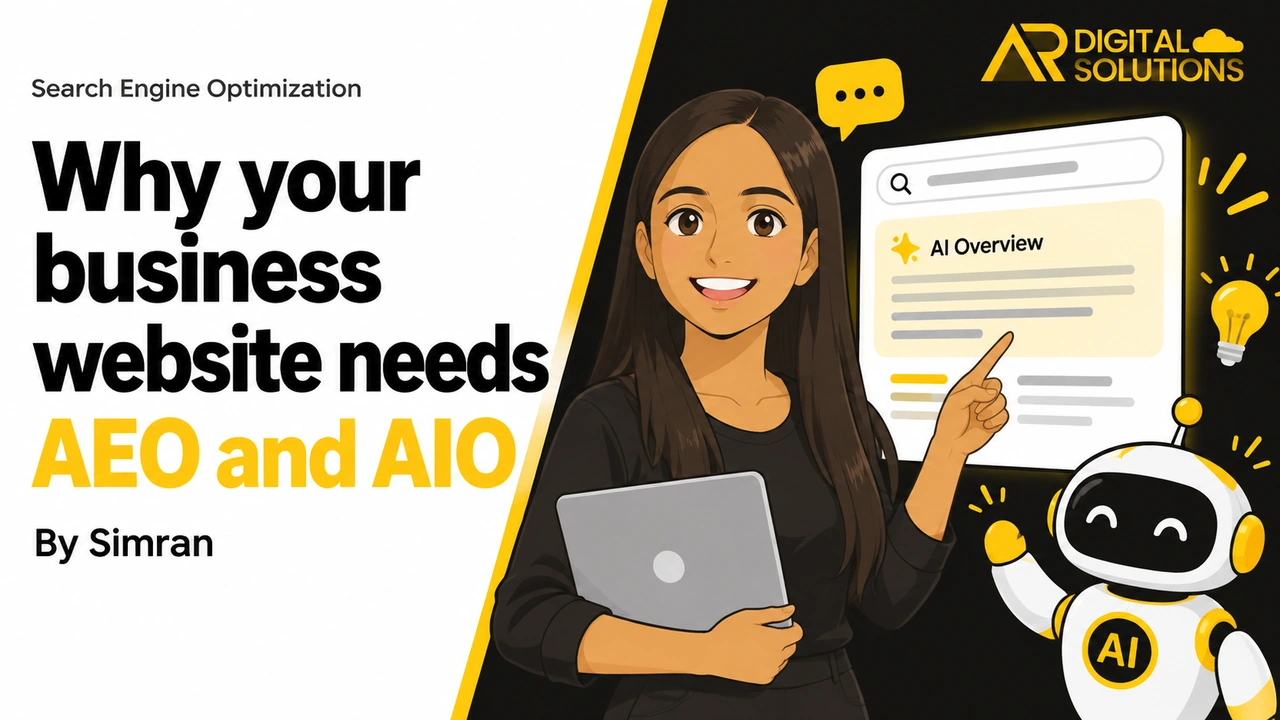
For years, getting found online meant one thing: ranking on the first page of Google. But the way people search has changed dramatically. Today your customers ask voice assistants, type full questions, and read AI-generated summaries that answer their query before they ever click a link. If your website is built only for traditional SEO, you are slowly becoming invisible in the places that now matter most. This is where AEO and AIO come in.
In this guide, we explain what AEO (Answer Engine Optimisation) and AIO (AI Optimisation) actually are, how they differ from the SEO you already know, and why your business website needs both to stay competitive. Both sit inside the SEO work we do for Brisbane businesses.
The way people search has fundamentally changed
Not long ago, a search returned ten blue links and the winner was whoever sat at the top. Three shifts are reshaping how customers find businesses:
- Zero-click searches: A large share of Google searches now end without a single click, because the answer appears directly on the results page.
- AI Overviews and chat answers: Google AI Overviews, ChatGPT, Gemini, Microsoft Copilot, and Perplexity now summarise answers and cite a handful of trusted sources, not a full page of results.
- Conversational and voice queries: People ask complete questions like "who offers affordable web design near me?" instead of typing two or three keywords.
Ranking number one is no longer enough if an AI assistant answers the question and never mentions your brand. To win visibility today, your content has to be the answer, and it has to be the source AI tools choose to trust and cite.
What is AEO (answer engine optimisation)?
Answer Engine Optimisation (AEO) is the practice of structuring your website content so that answer engines can pull a clear, direct response and present it to the user. Answer engines include Google featured snippets and the "People Also Ask" box, as well as voice assistants such as Siri, Alexa, and Google Assistant.
Where traditional SEO aims to rank a page, AEO aims to win the answer. It focuses on giving search engines a concise, well-formatted response to a specific question, the kind that gets read aloud by a smart speaker or displayed in a snippet above every other result.
AEO typically relies on:
- Clear question-and-answer formatting and FAQ sections
- Concise, factual answers placed near the top of a section
- Structured data (schema markup) that tells search engines exactly what your content means
- Natural, conversational language that matches how people actually ask questions
What is AIO (AI optimisation)?
AI Optimisation (AIO), sometimes called Generative Engine Optimisation, is the practice of optimising your content so that generative AI tools surface, summarise, and cite your business in their answers. When someone asks ChatGPT, Gemini, Perplexity, or Google's AI Overviews for a recommendation, AIO is what makes your brand part of that response.
AI models do not simply rank pages. They read, interpret, and synthesise information from sources they consider authoritative. AIO is about becoming one of those trusted sources. It centres on demonstrating real expertise, earning mentions across the web, and publishing content that is genuinely accurate, well-organised, and easy for a machine to understand.
Strong AIO usually involves:
- Demonstrating genuine expertise, authority, and trust (E-E-A-T) across your site
- In-depth, original content that answers the full intent behind a query
- Consistent mentions of your brand across directories, reviews, and reputable sites
- Clean site structure and schema so AI can confidently extract and attribute facts
- Up-to-date, factually accurate information AI models feel safe quoting
AEO vs AIO vs traditional SEO: what is the difference?
These three approaches are not competitors. They work together.
| Approach | Main goal | Where it shows up |
|---|---|---|
| SEO | Rank your page in search results | Standard Google and Bing listings |
| AEO | Win the direct answer to a question | Featured snippets, voice search, People Also Ask |
| AIO | Get cited inside AI-generated answers | Google AI Overviews, ChatGPT, Gemini, Perplexity |
Traditional SEO remains the foundation. You still need a fast, well-structured, authoritative site. AEO and AIO build on that foundation to capture the new ways customers discover businesses. Skip them, and you hand those customers to competitors who did the work.
Why your business website needs AEO and AIO
1. Visibility where decisions are now made
More buying decisions start inside AI assistants and answer boxes. If your business is the cited source, you reach customers at the exact moment they are looking for a solution, often before they even visit a traditional search page.
2. Authority and trust by association
Being quoted by an AI engine or chosen for a featured snippet signals credibility. Customers instinctively trust the brand the algorithm recommends, which builds confidence before they have even spoken to you.
3. Higher-quality, ready-to-buy traffic
People who arrive after an AI or answer engine has pointed them to you are further along in their decision. They already have context, so the visits you do receive tend to convert at a higher rate.
4. A competitive edge while it is still early
Many businesses have not adapted to AI-driven search. Investing in AEO and AIO now positions your website ahead of slower-moving competitors, an advantage that becomes much harder to claim once everyone catches up.
5. Future-proofing your online presence
Search is moving further toward AI and conversational discovery. Building your site for AEO and AIO today means you are ready for how people will search tomorrow.
How to optimise your website for AEO and AIO
You do not need to abandon SEO. You need to extend it. Here are the practical steps that move the needle:
- Answer real questions directly. Identify the questions your customers ask and answer them clearly, near the top of the relevant section.
- Add structured data (schema). Use FAQ, Article, Organisation, and Local Business schema so engines understand and trust your content.
- Write for humans first. Clear, natural, conversational language performs best for both voice search and AI summaries.
- Build genuine authority. Share your expertise, credentials, and reviews consistently across the web.
- Keep content accurate and current. AI models favour up-to-date, factual sources. Outdated pages get left out.
- Strengthen technical health. Fast load times, mobile-friendliness, and clean site structure remain essential foundations.
How AR Digital Solutions can help
At AR Digital Solutions, we help businesses across Brisbane, Queensland, and beyond stay visible as search evolves. Our team combines proven SEO fundamentals with modern AEO and AIO strategies, including structured content, schema markup, authority building, and AI-ready optimisation, so your website earns its place in featured snippets, voice results, and AI-generated answers alike.
Whether you are launching a new site or modernising an existing one, we can audit where you stand today and build a clear plan to capture the customers your competitors are missing.