
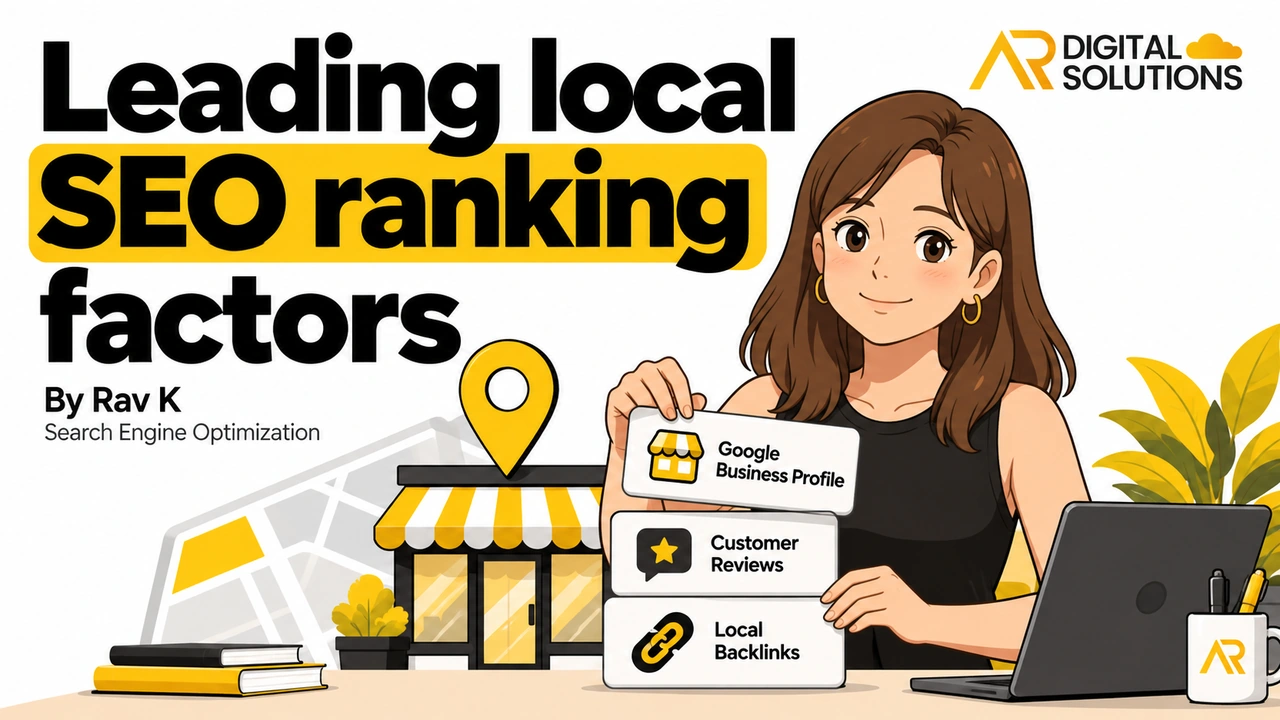
Local SEO is the practice of optimising your online presence so your business appears prominently when people search for services near them. For Australian businesses, particularly those serving specific cities or regions, local search performance is often more valuable than broad national rankings. It's usually where our Brisbane SEO work begins.
Around 30% of mobile searches are location-based, and more than three-quarters of people who search for a local business on their phone take action within 24 hours. Google displays two types of local results: the map pack, which shows three business listings with a map, and the organic results below. Appearing in both requires addressing a different set of signals than standard SEO. This article covers the factors that matter most.
1. Google Business Profile
Your Google Business Profile (formerly Google My Business) is the most direct lever for local visibility. It determines whether and how you appear in the map pack, knowledge panels, and location-based searches.
A fully completed profile consistently outranks incomplete ones. Key elements include:
- Business name, address, and phone number (NAP): These must match exactly what appears on your website and across other platforms.
- Business category: Choose the most accurate primary category. Google uses this to match your profile to relevant searches.
- Business description: Write a factual, keyword-aware description of what you offer and where you operate.
- Photos: Businesses with photos receive significantly more direction requests and website clicks than those without.
- Posts and updates: Regular Google Business Profile posts signal an active, maintained presence.
- Services and products: Listing individual services helps Google match your profile to more specific searches.
Treat your Google Business Profile as a live asset that needs regular attention, not a one-time setup.
2. Name, address, and phone consistency (NAP citations)
Your business name, address, and phone number appear in dozens of places across the web: your website, Google Business Profile, Facebook, Yellow Pages, True Local, industry directories, and local chamber of commerce listings, among others.
Google cross-references these citations to verify that your business is legitimate and that the details are accurate. Inconsistencies, such as a different phone number on one platform or an old address that was not updated everywhere, create conflicting signals that can suppress local rankings.
Audit your citations regularly. Use a consistent NAP format everywhere, and update all listings when details change.
3. Customer reviews
Reviews directly influence local rankings as well as click-through rates. Google weighs the quantity of reviews, their overall rating, how recent they are, and whether the business responds to them.
More than 85% of people check reviews before choosing a local business. A business with 47 reviews at 4.9-stars consistently outranks one with 6 reviews at 5.0 stars, because the volume and recency of reviews signal ongoing activity and real customer engagement.
Practical steps:
- Ask satisfied customers to leave a review on Google as a standard part of your follow-up process.
- Respond to every review, positive and critical, in a professional, specific way.
- Never purchase fake reviews. This violates Google's guidelines and carries real risk of profile suspension.
4. On-page local signals
Your website needs to reinforce the location signals you are sending through your Google Business Profile. Key on-page factors include:
- NAP on the website: Your business name, address, and phone number should appear in the footer and on your contact page, in plain text (not as an image).
- Location-specific pages: If you serve multiple areas, create dedicated pages for each location rather than listing them all on a single page.
- Local keyword integration: Include city and suburb names naturally within page titles, headings, and body content, particularly on service pages.
- Embedded Google Map: Including a Google Map on your contact page provides an additional local signal.
- LocalBusiness schema: Structured data markup that identifies your business type, address, phone number, and operating hours helps search engines understand your local relevance.
5. Mobile-friendly design
The majority of local searches happen on mobile devices. A website that does not perform well on a phone, whether due to slow loading, poor layout, or difficult navigation, creates friction between the search and the enquiry.
Google uses mobile-first indexing, which means it evaluates the mobile version of your site as the primary version for ranking purposes. A responsive design that works correctly across all screen sizes is a baseline requirement for local search performance.
6. Voice search optimisation
Voice queries tend to be more conversational and question-based than typed searches. Someone using a voice assistant might ask "who is the best plumber near me?" rather than typing "plumber Brisbane". Optimising for voice means using natural language in your content, including FAQ sections that address common questions directly, and ensuring your Google Business Profile is complete enough for voice assistants to confidently surface your business.
7. Backlinks from locally relevant sources
High-quality backlinks from locally relevant websites contribute to both domain authority and local relevance signals. For Australian businesses, relevant sources include:
- Local newspapers and community publications
- Industry associations and licensing bodies
- Local business directories and chambers of commerce
- Suppliers or partners who mention you on their websites
Quality matters far more than quantity. A single link from a well-regarded local publication is worth more than dozens of links from irrelevant or low-quality sources.
8. Behavioural signals
Google observes how users interact with local search results. Businesses that receive more clicks, longer visits, and direct interactions (calls, direction requests, website visits) from local searches gain an advantage in rankings over time.
This is one reason why your listing title, review rating, and first impression matter so much. If more searchers choose your listing over a competitor's, Google registers that as a positive quality signal.
Putting it together
No single factor controls local rankings. The businesses that consistently appear in the local map pack have addressed most of these areas: a complete Google Business Profile, consistent citations, genuine reviews, a mobile-optimised website with clear local signals, and ongoing activity that shows Google the business is real, active, and relevant.
Start with the Google Business Profile if yours is incomplete, then work through your citation consistency. These two areas often have the most immediate impact.
How AR Digital Solutions helps with local SEO
AR Digital Solutions manages local SEO for businesses across Brisbane, Gold Coast, and regional Queensland. We audit your current local signals, fix citation inconsistencies, optimise your Google Business Profile, and build the on-page signals that local searches rely on.
If your local rankings are not where they should be, a free audit is a good place to start.