
The short answer
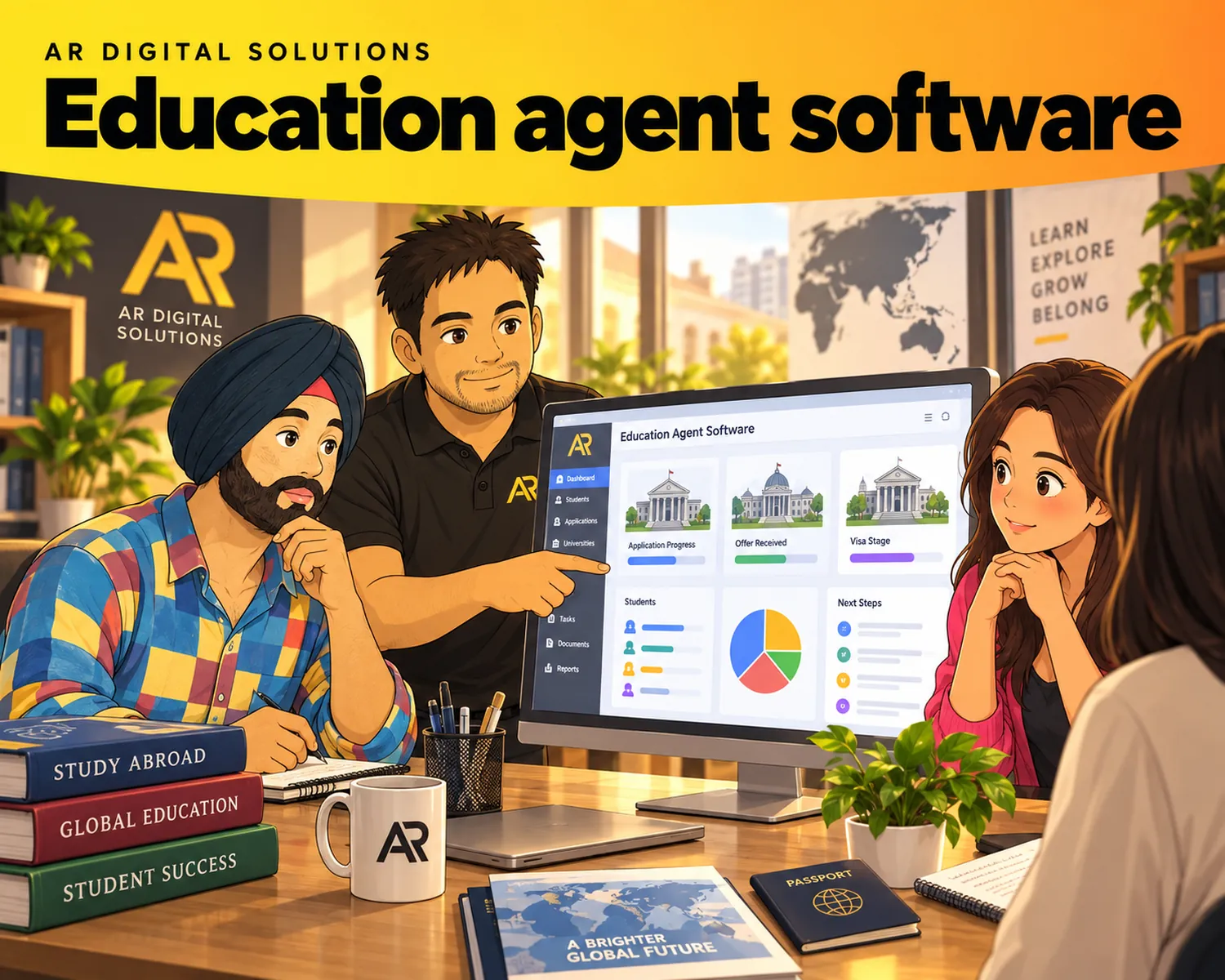
Education agent software tracks student enquiries, the separate applications each student makes to different institutions, the documents and conditions attached to every one, and the commission owed once a student enrols. AR Digital Solutions builds it for Australian agents when off the shelf student CRMs don't match how the office runs.
A student pipeline is not a sales pipeline
Most CRMs assume one opportunity, one value, one stage and one close date. That describes a plumbing quote. It does not describe a student.
One student produces several applications. Someone chasing a business qualification might apply to two private colleges and a regional university at once, and each has its own offer letter, conditions, intake and commission rate. A single pipeline makes you pick one stage for that student. Offer received, because a college replied on Tuesday? Or documents outstanding, because the university wants a second English result? Both are true, and one stage field makes you lie about one of them.
You're also waiting on two parties at once. The student gets chased over WhatsApp, sometimes through a parent in another time zone. The institution gets chased by email, and an admissions officer takes eleven days when busy. Merge those into one task list and the loud one wins, which is how an application sits unassessed for a fortnight.
So the shape is different. The student is the record, holding passport, visa status, education history, English results and funding, entered once and reused. Applications are children of it, each with a status, an intake and an outcome, so a student can be enrolled at one provider and rejected at another without argument.
Document checklists belong to the application, because one provider wants a work reference and another wants a financial capacity declaration. Status matters more than existence: received, verified, expired, resubmitted. Conditions on an offer are items you tick off with a date against each.
Commission is tracked per application, never per student. Rates differ by provider and often by course, timing differs, and clawbacks apply when a student withdraws early. Put commission on the student record and you can't reconcile a remittance against what you were owed, so you accept whatever arrives.
Then there's compliance. Providers hold written agreements with their agents under the ESOS framework and the National Code, and agent details are recorded against enrolments. Those records are what you rely on when a provider asks how a student was recruited.
What an agent's system has to hold
- Enquiry capture from web, social and WhatsApp, with the source recorded.
- The student as the single source of personal data, reused across every application.
- Several live applications per student, each with its own status, intake and deadline.
- Document checklists per application, carrying status and expiry rather than a folder of attachments.
- Offer and condition tracking through to enrolment confirmation.
- Commission per application, reconciled against provider remittances.
- Sub agent splits, and reporting by intake, provider and counsellor.
Four stages, and you know the number before stage two
We map the office
How enquiries arrive, who assesses them, and where the process leaks.
We scope and price it
Fixed number, dates in writing, plus what version one leaves out.
We build it
You watch progress on a staging link, not in a status email.
We migrate and train
Your data comes across and we stay close through the first intake.
Who this suits, and who it doesn't
It suits agencies past the point where one person holds everything in their head. Several counsellors, multiple provider agreements, and commission income large enough that a two per cent gap matters.
It doesn't suit one counsellor sending a handful of students to a single provider each year. That's a spreadsheet, and we'll say so rather than quote you. If you already pay for a CRM platform, the honest answer is sometimes configuration rather than a build, and that's the first thing our CRM consultants look at.
Why build it here
We know the sector.
We've done marketing and automation work inside student and migration practices, so nobody is learning what a CoE is on your time.
The developers are ours.
All 32 staff are in house, and you talk to the person building your system.
You own the code.
Repository, configuration and documentation, handed over on request.
"We've been burned before."
Usually the same story: a big number, a long silence, then something half working. So the scope gets written before the price.