
The short version
When rank tracking began on 29 May 2026, one tracked keyword was on page one of Google. As of 17 September 2026, 12 of Seareal’s 75 tracked keywords are on page one and 5 sit in the top three. (Source: SE Ranking rank tracking, Google Australia.)
What we did for Seareal
- Website designPlanned, designed and built by our own team, then kept up to date.
- SEOTechnical fixes, content and links, reported by enquiries not rankings.
What we delivered
Seareal did not hire one service. They hired a team that does website design and SEO under one roof, so nothing falls between suppliers. We designed and built the website, structured for search from the first wireframe rather than optimised after the fact. The SEO programme runs on top of that: technical fixes, content written for the searches that actually turn into enquiries, and links earned in the client's own market.
The result is a marketing setup the client can call one number about.
The client
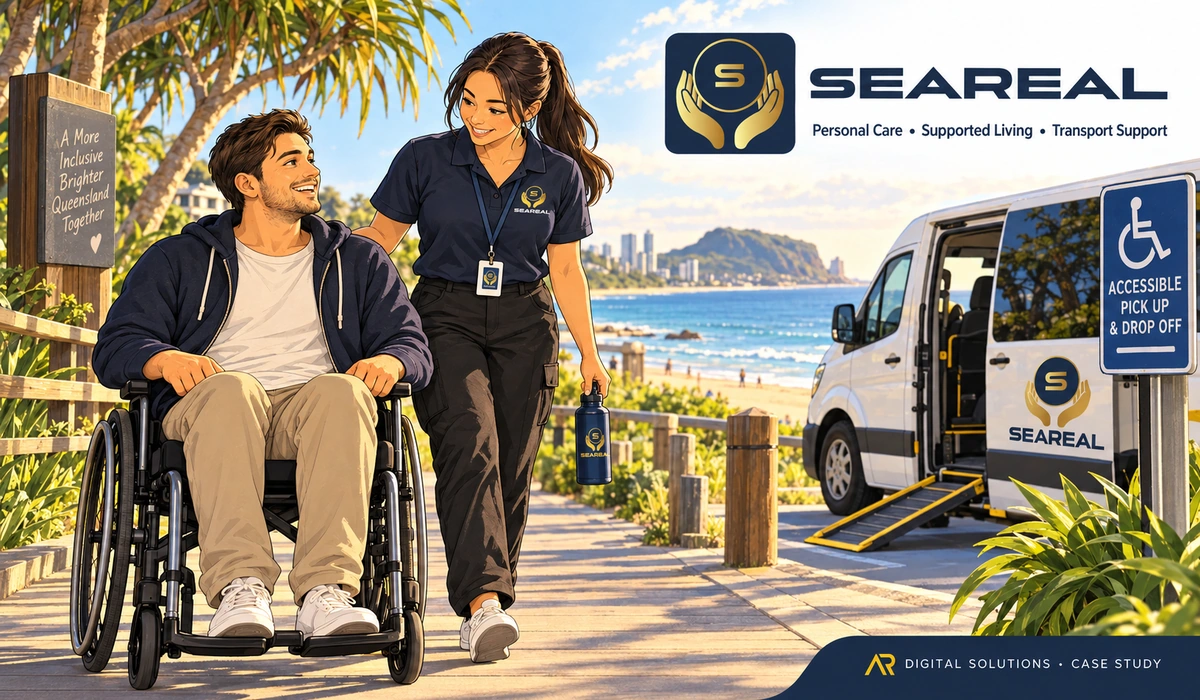
Seareal delivers NDIS supports across five Queensland regions, including Cairns, Townsville, Mackay, Rockhampton and the Sunshine Coast. Its services cover personal care, shared independent living (SIL) and transport support.
The challenge
Providers that work across several regions often end up with one generic services page. Google then has a hard time matching the business to searches like “shared independent living Townsville”, because nothing on the site speaks to that town.
The easy fix, copying one page and swapping the town name, rarely works well. Near-duplicate pages give Google little reason to rank any of them, and they don’t help participants or support coordinators who want local detail.
What our team did
Keyword research by region
We pulled Australian search data in SE Ranking and grouped keywords by service and region. Many regional NDIS searches show little or no measured volume, so we planned pages around real intent rather than volume alone.
Location-differentiated service pages
We wrote pages for personal care, SIL and transport support in each region. Each page was written to stand on its own, with content that reflects the area rather than a find-and-replace template.
A full SEO bundle on every page
Every page shipped with a checked title tag and meta description, focus and secondary keywords, internal links, image alt text and schema recommendations (FAQPage, Service, LocalBusiness and BreadcrumbList).
Build and QA
Pages were generated as PHP files with clean URLs, ready for cPanel. Before delivery, our team ran automated checks on character counts, banned vocabulary and Australian English.
Rank tracking by region
We set up SE Ranking with keyword groups for each region, so progress in one town isn’t hidden by another.
Results
29 May 2026 (tracking starts): 1 tracked keyword on page one. Some keywords may have been added to tracking after this date, so it isn’t a perfect like-for-like comparison.
As of 17 September 2026:
- 12 of 75 tracked keywords on page one, and 27 in the top 30
- #1 for “Shared Independent Living Cairns”
- #2 for “Shared Independent Living Townsville” and “Shared Independent Living Rockhampton”
- #2 for “NDIS Transport Support Mackay”
- #5 for “ndis providers rockhampton”
- #6 for “NDIS Transport Support Townsville” (about 10 searches a month)
- #10 for “ndis provider rockhampton” (about 40 searches a month)
Most of these regional searches are small, and that’s normal for NDIS. The people typing them are usually close to a decision, so a page-one spot matters more than the volume suggests.
Source: SE Ranking rank tracking, Google Australia, as of 17 September 2026. Rankings change and past results aren’t a promise of future ones.
Fun fact
Google’s Knowledge Graph launched in 2012 with the slogan “things, not strings”. It marked a shift from matching words to understanding entities, which is why a clear link between a service and a real place helps local pages.
Marketing tip (lesson learned)
Before you publish a set of location pages, read two of them side by side. If you could swap the town names without anyone noticing, rewrite one of them with local detail, such as the areas you visit or how participants get to community activities.
A note on results
Results vary from client to client. They depend on the package chosen and the marketing budget the client puts behind the project, so what you see here reflects that client's spend, not a fixed outcome. Talk to us about a budget that fits your goals.
Related services
Our team builds marketing for NDIS providers that respects the sector’s rules and the people it serves. If you cover more than one area, our local SEO work and regional pages like SEO on the Sunshine Coast are a good place to start. You can also browse all case studies.