
The short answer
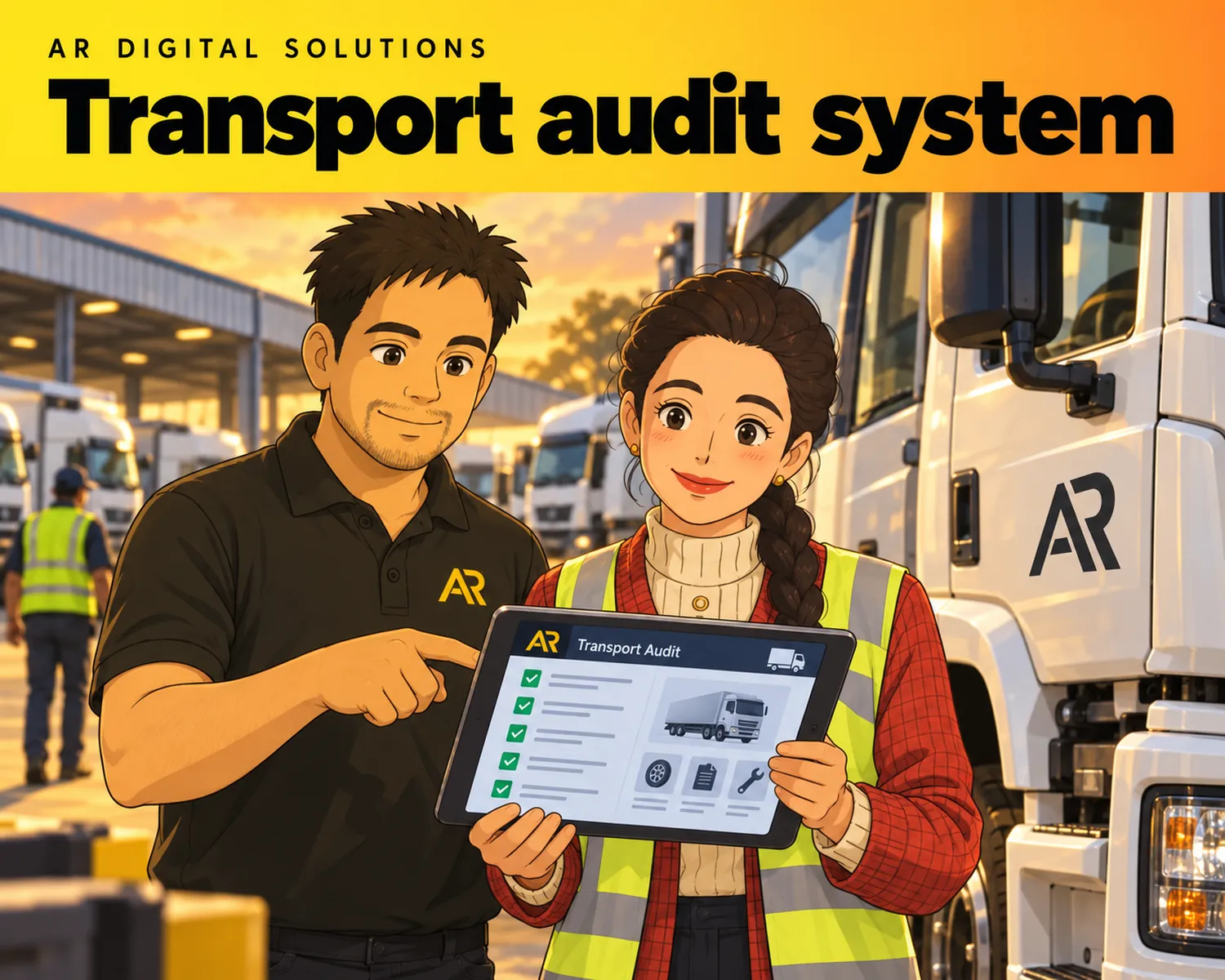
The transport audit system is compliance record keeping software built by AR Digital Solutions for Australian fleet operators. Checks, driver records, faults and corrective actions are captured with a time, a name and a photo attached, then retrieved by date, vehicle or driver when someone asks.
What the system has to hold
- Checks completed in the field, stamped with when they were done rather than when they were typed up.
- The person who did them, identified, not a signature scanned off a paper form.
- Photo evidence attached to the item it relates to, not to a folder.
- Faults raised, and what happened next, through to sign off.
- Vehicle and driver history, retrievable across a date range in a couple of clicks.
- A visible trail of edits, and alerts for what's due, expired or missed.
Why good operators still fail audits
Doing the work and proving the work are separate jobs, and most operators resource only the first.
Your drivers do the walk arounds. Faults get reported and fixed. Then an auditor asks for three months of records covering two vehicles and one driver, and the evidence is spread across a book in a ute glovebox, a WhatsApp thread where someone sent a photo of a cracked mirror, a filing cabinet, and one person's memory of a phone call. The work was done. It just can't be produced.
An auditor can't accept what can't be produced, and that isn't unfairness. They're there to see whether your system produces evidence, and a system nobody can retrieve from looks the same as no system at all.
So what makes a record defensible? Four things, and paper struggles with all four.
Timestamped.
Not the date written at the top of a page. The time the check was completed, recorded by the system rather than the person. A pre start logged at 4.55am reads differently to one entered at 3pm along with the rest of the week.
Attributable.
Tied to an identified person who was logged in. A tick in a book proves a tick in a book, not who stood next to the truck.
Tamper evident.
Records get amended, often legitimately: a wrong odometer, a fault logged against the wrong trailer. What matters is that the change is visible, with the original value, the new one, and who made it. A record that can be quietly rewritten carries no weight, and one that can never be corrected just gets falsified instead.
Retrievable.
By date, by vehicle and by driver, in front of the person asking. If producing six months of records for one truck takes two days of digging, that's an archive, not a compliance system.
There's a fifth thing that matters more, and it isn't a records feature. It's whether a raised fault has a visible ending.
Most findings aren't missing checks. They're checks that found something, after which nothing traceable happened. The driver reported the brake light. Someone probably rang the mechanic. Whether it was repaired, when, and who confirmed it live in a conversation that no longer exists. A defect with no recorded resolution reads worse than one nobody reported, because it shows the system saw the problem and dropped it. Every raised item needs an owner and a close out with evidence.
One more thing: this only works if capture happens in the yard, on a phone, in under two minutes, at the start of a shift, in the rain. A system that relies on drivers writing things down for the office to type up later has recreated the paper problem with an extra step.
How it goes in
We map what you already do
Your checks, forms and escalation path. The system follows your operation, not the reverse.
We agree scope and price
Fixed number, dates in writing.
3. We build and configure it, including how records get out for an auditor.
We roll it out to drivers first
If the yard doesn't adopt it, nothing else matters.
Who it's for, and who it isn't
It suits fleet operators who get inspected, businesses whose contracts require evidence of compliance, and anyone whose records rest on one person's diligence.
It isn't for an operator with two vehicles and no reporting obligations. It also isn't advice on what you're required to keep, which is a conversation for your compliance adviser. We build the system that holds the records, to the requirements you confirm. Construction and trade fleets sit in the same position, covered on the trade and construction page.
Why bring this here
In house developers, who also run the servers holding your records. More on the apps and custom software page.
No lock in contracts*, and the data is yours to export.
One account manager, not a ticket queue.
"Our drivers won't use it."
Some won't at first. The ones who do are the ones whose job got shorter, so the form has to be quick and work with gloves on and no signal.