
The short answer
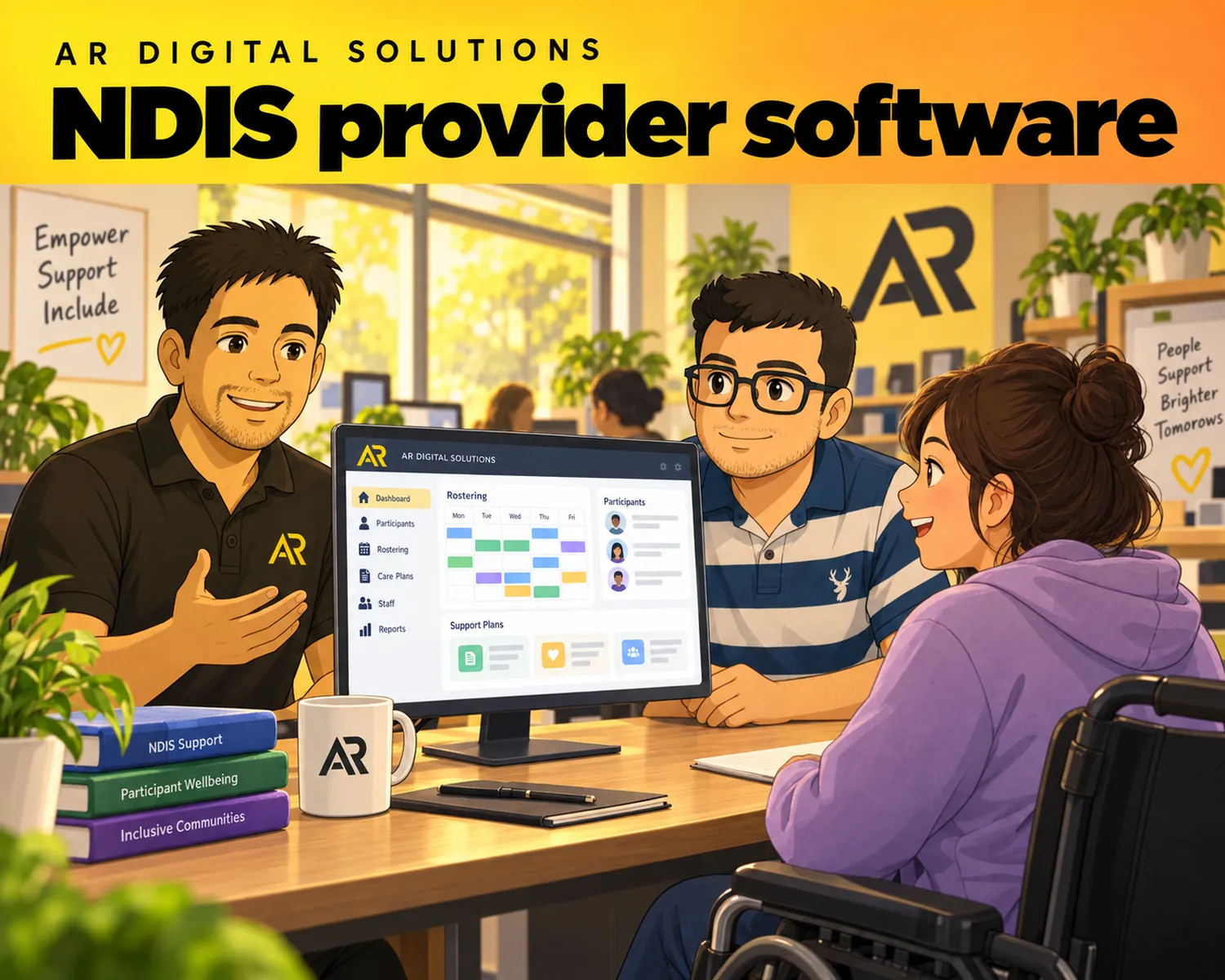
NDIS provider software manages participants, service agreements, rostering, progress notes and the claiming process in one place. AR Digital Solutions builds these systems for Australian providers. We are a software and marketing company. We are not an NDIS provider, and each provider remains responsible for their own compliance.
What the system has to hold
- Participants, their plan details and the people around them.
- Service agreements, and what each one actually covers.
- Rosters that match workers to participants, not just to hours.
- Shifts carrying the funding information they will be claimed against.
- Progress notes attached to the shift and the participant.
- Worker qualifications, checks and expiry dates.
- Claim preparation, and a view of what hasn't been claimed yet.
Why NDIS admin is heavier than ordinary rostering
Rostering software for a cleaning company answers one question: who is working, when. Once the shift is worked, the record exists mainly for payroll.
A support shift is a different object. Before it happens it has to tie back to a participant, a service agreement saying this support was agreed, a funded support category with money left in it, and a line item it can be claimed against afterwards. Get one of those wrong and the shift still happens, the worker still gets paid, and the money doesn't arrive. General rostering tools validate against staff availability, so the errors they catch cost you a shift, not the payment.
The software has to carry funding context all the way through, from the agreement into the roster and out the other side. When a coordinator books a shift, the system should already know what the participant agreed to and what remains, and it should handle a shift that runs over, gets cancelled late, or gets picked up by a different worker in a different ratio.
The workforce record sits on top of that. Checks and qualifications expire, and an expired one isn't a footnote when the shift is already rostered, so expiry dates belong beside the roster.
A CRM built around a customer who buys repeatedly holds none of this shape, which is why so many providers end up with a rostering tool, a spreadsheet of agreements and a drive full of notes that won't reconcile at month end. Our CRM consultants look at that split first.
A note has to be quick enough to write in the car and complete enough to survive an audit
The progress note is the point where the system either works or gets quietly abandoned.
It's two documents pretending to be one. For the participant and the next worker it's a care record: what happened, how the person was, what the next shift needs to know. For everyone else it's evidence, read years later by someone who wasn't there, alongside the claim it supports.
Those readers pull the design in opposite directions. Auditability wants detail and completeness. Reality is a support worker in a car with ten minutes before the next visit, on a phone, sometimes with no signal. If a note takes fifteen minutes of typing it doesn't get written then. It gets written at 9pm from memory, or on Friday for the whole week, and a note reconstructed on Friday is a weaker record than one written at the door.
The design that works removes typing without removing substance. Structured fields for what the system already knows: participant, worker, start and finish, supports delivered. Free text for the part that varies, which is what happened and what changed. Prompts drawn from that participant's own goals rather than a generic template. Voice capture where it suits, and offline capture always.
The audit side is mostly about what happens around the note rather than in it. A timestamp of when it was written, not just the shift date. A visible edit history rather than silent overwriting. A link from note to shift to claim, so the record and the money trace both ways. Storage in Australia, with access by role.
If your workers hate writing notes, that's a design problem, and it shows up later as an evidence problem.
Where our scope ends
We build and support software. We are not an NDIS provider, we deliver no supports, and we give no advice on registration, audits or pricing rules.
Scheme rules, price arrangements and claiming requirements change, so we don't restate them here as fixed facts. We build to the rules your organisation confirms, make them straightforward to change later, and hand the setup to your compliance people before go live. Responsibility for your compliance stays with you.
How it goes in
1. We map your process with the people doing it, spreadsheets included.
2. We agree scope and price.
Fixed number, dates in writing.
3. We build, migrate and run in parallel over a full claim cycle.
4. We train coordinators and support workers separately.
They use different halves of it.
Who it's for, and who it isn't
It suits providers who have outgrown a rostering tool plus spreadsheets, and providers running several service types where funding differs by type.
It isn't for a sole worker with a handful of regular participants, and it isn't automatic if you already pay for a platform. The answer is often configuration, or an integration between two systems you already have, which is what our custom integrations team looks at first.
Why bring this here
Developers in house, and the same team runs the hosting. A Sydney data centre matters when the data is this sensitive. The rest of our software work sits on the apps page.
We already work in the sector.
Our NDIS marketing and websites work puts the constraints in the brief rather than discovering them late. No lock in contracts*, and your data is exportable on request.
"Our last system was built for a hospital."
Software written for clinical settings assumes a building, a handover and a ward. Community support assumes a car, a phone and a house.