
The short answer
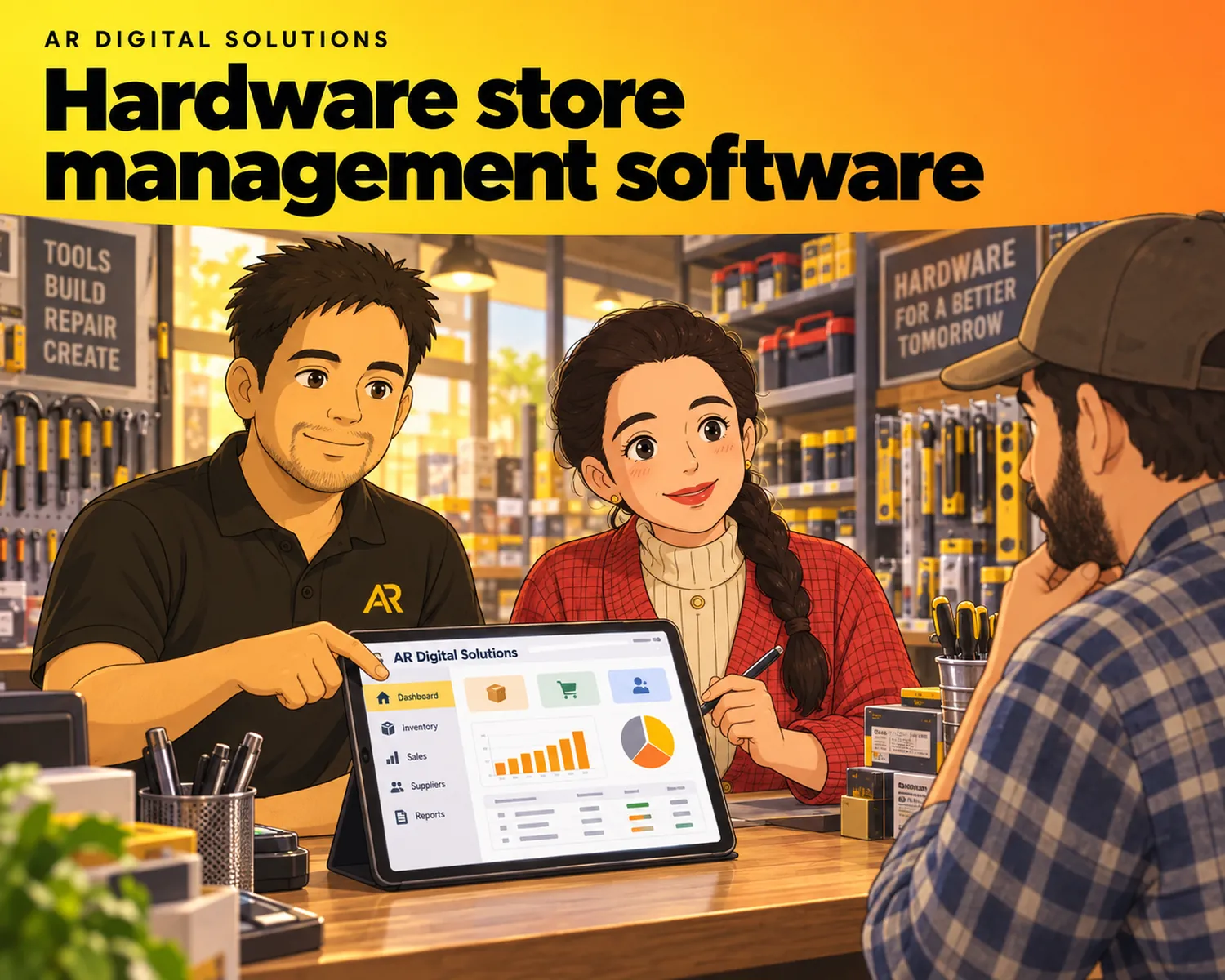
Hardware store management software from AR Digital Solutions covers the parts of an independent store that retail POS ignores: trade accounts with their own pricing, quotes that become orders, part deliveries and back orders, and a counter that keeps working when the connection drops.
What the system has to cover
- Trade accounts, with pricing that follows the customer rather than the product.
- Quotes that stay open, get drawn down over several visits and convert without re keying.
- Orders that ship in parts, with the balance visible to counter and customer.
- Stock measured the way you sell it, including by length and by pack.
- Supplier ordering that consolidates shortages into an order worth placing, and receiving that copes with short deliveries.
- Statements, credit limits and terms that reconcile with your accounting file, and a counter that keeps trading when the internet is down.
Why retail POS keeps failing in hardware
Mainstream retail POS is built for a shop where someone picks an item up, pays and leaves. Little of that describes a hardware store. Six things break, and they break at the counter with people waiting.
Trade accounts and account specific pricing.
Retail POS assumes one price per product, with maybe a loyalty discount on top. Hardware runs price levels per customer, and for a large builder, negotiated prices on individual lines. The account needs a credit limit, terms and a statement at month end. If the system can't put a sale on account, staff write a docket, and within a year the docket book has quietly become your accounts receivable. That's also how you keep serving someone who stopped paying eleven weeks ago.
Quotes that turn into orders.
A builder wants a price on 40 items and expects it held. Then they take a third on Tuesday, a third next week, and never come back for the rest. Retail POS has no concept of an open quote you draw down, so quotes get built in a spreadsheet and re keyed at the counter. That's where pricing errors come from.
Part deliveries and back orders.
One order, half picked up now, the rest on back order. You invoice what left the store, keep the remainder visible to the counter and the customer who rings Thursday, and know what's owed when the pallet lands. Generic POS assumes the sale finishes when the customer walks out.
Timber and length based pricing.
Stock sold per metre, priced per length, cut to size, with the offcut still worth something. The same item might sell as a single length, per pack and by the metre in one afternoon. A system with one unit of measure either prices it wrong or counts it wrong, so staff override the price and margin reporting becomes fiction.
Supplier ordering against minimums.
Reorder points aren't the hard part. Suppliers have minimum order values, pallet quantities and set delivery days, so ordering isn't item by item. It's assembling a week of shortages into one order that clears the minimum without loading you with stock that sits, then receiving it when the supplier shorts two lines and substitutes another.
The counter working when the internet drops.
This one decides whether the software survives. Connections drop, especially in regional stores, usually on a Saturday morning with six people in line, and a cloud only system stops the store trading. Offline means the terminal holds current pricing and stock, sales queue locally and reconcile when the link returns, and someone has decided in advance what happens with credit limits nobody can check.
Underneath all six sits one point. The person behind the counter knows more than the system does, so the software's job is to stay out of the way. Fast search on partial codes, supplier codes and the words customers use. Anything that adds fifteen seconds a line gets worked around by lunchtime.
How it goes in
1. We map how you sell.
Accounts, price levels, quoting and ordering, before anyone talks software.
2. We agree scope and price.
Fixed number, dates in writing.
3. We build and migrate, testing with real stock data, because catalogue and pricing migration is where these projects go wrong.
4. We train on the counter, in the store, not in a meeting room.
Who it's for, and who it isn't
It suits independent hardware stores, timber and building supply yards, rural merchandise stores, and any counter where trade accounts and cash sales share a queue.
It isn't for a small shop with no accounts and no back orders, where an off the shelf POS does the job for a fraction of the money. Selling in a way no product covers, outside hardware? That's POS and billing systems.
Why bring this here
In house developers, who also run the hosting behind it. More on the apps and custom software page.
No lock in contracts*, and your data stays yours.
One account manager, who knows your store.
"Our stock file is too messy to migrate."
Most are. Duplicate codes, dead lines, prices that make sense to one person only. Cleaning it is real work, and it belongs in the build rather than after it.