
The short answer
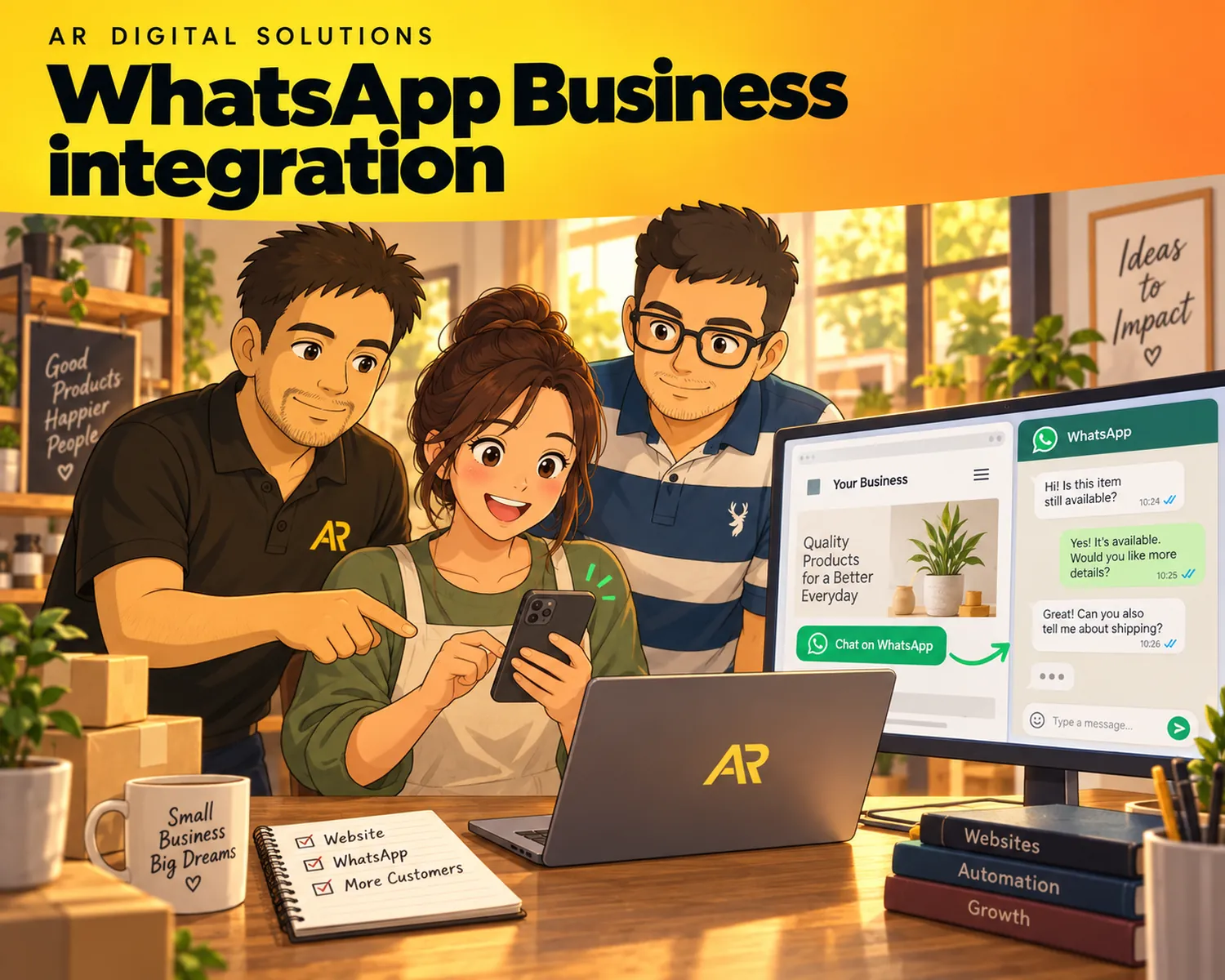
A WhatsApp Business API integration connects the WhatsApp Business Platform to your CRM, store or custom application so messages send off your own events and replies land where your team already works. AR Digital Solutions handles account setup, template approval, automation and the data sync behind it.
What the build usually covers
- Business account, number registration and display name verification.
- Template writing, categorisation and submission.
- Window aware sending, so the system picks free form or template correctly.
- Inbound webhooks, with replies routed to the right person or workflow.
- Conversation history written against the customer record in your CRM.
- Opt in capture and opt out handling across every channel you send on.
Templates and windows, the rules that decide whether your number survives
The 24 hour customer service window
When a customer messages you, a 24 hour window opens. Inside it your system can send free form messages with any wording and any media, no approval involved, and each new inbound message restarts the clock. Outside it, only an approved template will go, and the API rejects anything else with an error.
So the integration has to track the last inbound message per contact and pick the message type on the way out. Teams get caught when an agent drafts a reply 26 hours later and nothing falls back to a template.
How template approval works, and why templates get rejected
You submit a name, a category, a language and body text with numbered placeholders plus sample values. Review is largely automated and rejections are usually deserved. Marketing wording submitted as a utility template. Sample values missing or filled with nonsense. A placeholder alone at the start of a message, so nobody can tell what will be sent.
Each language is a separate template, and editing one sends it back through review, so a last minute wording change needs the time built in.
Quality rating and messaging limits
Every sending number carries a quality rating driven by how recipients react, mostly blocks and reports. It follows the number, not the account. Drop far enough and your messaging limit falls, then sending is restricted, then the number can be disabled. Limits step up as you message more unique customers, so a business that ramps gradually ends up sending more than one that opens with a blast.
A purchased list is the fastest way to lose the number
People who never gave you their number block on sight, and blocks early in a number's life carry more weight. The number you lose is the one printed on your van and your invoices, and getting it back is slow. Consent gets captured and stored before a single message is built.
What WhatsApp genuinely does better than SMS or email in Australia
Everything sits in one thread the customer can scroll back through, so nobody rings asking you to resend the quote. Media works properly: photos of the job, a PDF quote, a location pin. Replies land in the same conversation, so you get an exchange rather than a notification nobody can answer.
Then there's who your customers are. Across much of Australia's migrant population, among international students, and for anyone dealing with suppliers overseas, WhatsApp is the default messaging app rather than a second one. If customers already message a staff member's phone, you're running this channel informally.
Email still wins for long documents. For a two line question that needs answering today, it doesn't. Where the messaging is marketing rather than service, our WhatsApp campaigns team runs that side.
How the build runs
We check the fit
Number choice, verification, and whether your customers use the app.
Scope and price
Fixed scope, fixed number, dates in writing.
Build and submit
Opt in capture, window logic, webhooks and templates, submitted early enough to survive a rejection.
Launch and monitor
Quality rating and messaging limits watched, not discovered later.
Who this suits, and who it doesn't
It suits businesses whose customer conversations live on someone's personal phone, and anyone whose customers message rather than email.
It doesn't suit a business with no consented list and no plan to build one.
Why build it with us
Meta Business Partner, with developers in the same building.
Account work and code sit with one team, so nothing waits on a third party.
You own the asset.
Your business account, your number, your templates and your conversation data.
No lock in contracts*.
Month to month on retainers, fixed scope on projects.
"We already reply from a staff phone."
Until that person leaves with the history, or someone opts out and gets messaged anyway.